05 June, 2007

Finsbury Park to Hornsey on the new river path.

For the curse of water has come again because of the wrath of G*d
And water is on the Bishop's board and the higher thinker's shrine
But I don't care where the water goes if it doesn't get into the wine.


An evening walk from Finsbury Park to Hornsey on some of the most boring and dangerous roads in Harringay if not London as a whole. I started out at Finsbury Park Station when I should have got off the train at Manor House. Never mind. Finsbury park is quite attractive to walk through with a pleasant avenue, although you do have to dodge the bicycles and the drunks. Meeting the new river in the corner of the park, I lost it again at the main road. The only redeeming feature of the car-choked Wightman Road was the wonderful post modernist church of St Paul, Harringay (see illustration). The original church was burnt down in 1984 and was rebuilt with a new organ which is apparently exceptionally good. The attached accomodation for the incumbent was also post modernist.

The path by the new river is closed at the request of Harringay Council although much of the New River is open here. There is a tunnel and when I rejoined the river it was at the end of this tunnel where there was a barrage attracting flotsam of very dubious charm! I saw all sorts of refuse in the river here as it ran next to the East Coast Main Line, again the river was on an embankment. I soon needed to leave the river and go via three sides of a triangle to arrive in Hornsey.

There was building work taking place on a pumping station and water treatment works site (luxury flats no doubt) and the path was closed. It was here I saw a Thames Water Authority coat of arms, a combination of the LCC and New River coats.
So I decided to explore Hornsey. I went past a church tower, minus church, that looked like it had been bombed. Actually it was demolished in 1927 and a new church built nearby. Drat, I didn't see the new church and didn't even look! Then I had a walk round Priory Park, complete with three fountains and two people with dogs breaking into the paddling pool. The third fountain was in the 'philosopher's garden' named after a group of old men who meet there in order to have 'casual conversation. The park was a lot more run down than Finsbury Park but there was good play equipment. There were some curious houses round about, including what looked like war surplus buildings - the sort with the crittall windows and the flat overhanging roofs transformed into flats.

Coming out of the park I called in on my friends Jason and Liz. Jason showed me Hornsey Common which had been planted as a wild flower garden - at vast expense.

24 May, 2007

On the new River Path from Broxbourne to Enfield

AMWELL, perpetual be thy stream
Nor e’er thy spring be less,
Where thousands drink who never dream
Whence flows the boon they bless.

Too often this ungrateful man
Blind and unconscious lives;
Enjoys kind Heaven’s indulgent plan
Nor thinks of Him that gives.

So says the quaker poet, and good quality water is certainly a boon but this path isn't. It's dull, dull, dull, although there were a few good photo ops.

The photos show (a) the first glimpse of Canary Wharf (the building with the pointy roof shown in the blue circle in the smaller photo.


This next photo shows the M25 London Orbital motorway which the New River crosses the motorway by way of an aquaduct in two concrete channels.
The final picture shows the Docwra Aqueduct which doesn't really do anything as the New River is actually diverted to Walthamstow reservoirs.
Really this walk went past some very dull areas, and even Theobald's Park, that royal spot, didn't add anything to the thrills. I think I'll breathe a sigh of relief when it's over.

On the way back, via Great Cambridge Road I saw a conservation area on a council estate and a great big church of the 1920s. I think this will provide much better fodder.

20 May, 2007

Salford (and Manchester)

When I visit Manchester I usually stay in Salford, so I thought I'd have a look around Salford for a change. Salford is little brother to Manchester and appears in the bit I visited to be much more run down. It is the place where Coronation Street (tm) is based. There is the eighteenth century church of the Sacred Trinity, which has a goth night on one of the fridays in the month. It is also cris-crossed with railway lines.

18 May, 2007

Portsmouth

A visit to Portsmouth for the Benenden Society Conference. The conference was held in the Portsmouth Guildhall, a Victorian structure that appeared to have been rebuilt in the 1950s possibly after bombing. The hall was quite opulent with tapestry hangings at high level.
Portsmouth and Queen Mary share a motto - Heaven's light our guide - which in Portsmouth's case I assume relates to Navigation. I don't know why Queen Mary (nee Mary of Teck) had it or who had it first.
Portsmouth is always quite an exciting city guided by heavenly light or not. It has a large naval population and a large student population too. The pubs are certainly lively, and the swearing from the Navy girlfriends and wives is quite surprising to hear in the pubs and clubs. There are lots of coöp stores in the town but you'll have to see the other blog for those.

The conference dinner was held in the shadow of the fairly new Spinnaker tower

in one of the boathouses in the historic naval dockyard. We had a very good (cold) dinner and entertainment by a local band. The DEFRA delegation strolled back to the hotel around midnight.
Portsmouth is worth going back to.

07 May, 2007

Brighton

A May Day visit to Brighton to go to a party at Mike and Ken’s. A most enjoyable party but the weather was unkind and very gloomy. The seas were rough too so here’s a historic picture of rough seas at Brighton.
Posted by Picasa

04 May, 2007

Hertford to Broxbourne on the new river path

"He maketh the wilderness a standing water
And water springs of a dry ground
And there He setteth the hungry
That they may build them a city to dwell in"

"He opened the rock, and the waters gushed out;
They ran in the dry places like a river."

Thus says the psalmist and this was Hugh Myddleton's vision. London was thirsty and Hertfordshire was wet (it still is). A new river was needed to quench the thirst of the capital and bring water to London. Royal Jeweller to King James I and VI Myddleton was main promoter of the new river.

It wasn't too easy to find New Gauge, the official start of the New River and the New River Path from Hertford East Station, but I made it eventually. The gauge measures the amount of water Thames Water takes from the River Lea to supply North London with its drinking water. It is many millions of litres a day. The New River is then fed by an enormous spring, forming a small lake at Chadwell with an old gauge building, more of a shed really. The New River still provides around 8% of London's drinking water and the route passes Amwell where there are stone monuments to Hugh Myddleton. These are inscribed with poems which has inspired me to begin each section of this walk with a poem. After Great Amwell the path passed by the Great Amwell War memorial and passes Stanstead St Margarets. At Stanstead St Margarets there is a very large ecclesiastical looking building which I believe is a school. It is also the home to SM Coaches, which always amuses me when I go to Harlow.

I had to deviate from the path at this point, walking past a school at chucking out time - a most unpleasant experience. I got back on to the New River and came to Rye House. By this time I was in need of refreshment so I called in at the pub for a refreshing lime and soda. Rye house is now an RSPB Bird sanctuary but it was at the centre of a (possibly manufactured) plot to assasinate Charles II and his son James who had converted to Roman Catholicism and prevent a return to the throne of a Roman Catholic. The plan was to ambush Charles and James as they came back from the races at Newmarket, a regular haunt of the 'merry monarch'. Unfortunately there was a fire in Newmarket and the races were cancelled and thus the King his son went home early. All that remains of Rye House is as shown in the photo. The New River has a gentle slope of about 1:100 which means it is very level. The next point of interest was Ware as in the great bed of Ware, now in the V&A Museum. The Great bed is around 11 feet square and was made as a tourist attraction. It can sleep five or six people, which must have been very warm. "'ere: stop poking me!"
Ware is a pleasant town for a stop to eat lunch and visit. It has a lot of buildings that would be black and white if the plaster was removed, although black and white buildings were traditionally covered with plaster giving the origin of the name 'Pargeter'.
I didn't see much in Ware but was soon back on the New River. Passing some pumping stations and the backs of houses and crossing busy roads was not ideal but functional. The river runs on an embankment which is most peculiar. I decided to stop at Broxbourne, where there is a bus service to Harlow, and where I also once saw three young men use the river as a urinal after a drunken night out (on their part, not mine).

03 May, 2007

Southend and Rochford

A visit to Southend. Southend is an Essex seaside resort with the usual facilities, including the longest pier in Britain. The pier is so long there is a railway on it to take visitors to the end. I didn't go on the pier but I walked along the front, although it is a River Thames estuary front rather than a sea front. On the front there was a party of girls from a girls school who asked me if I could answer some questions. I was desparate for the loo at the time so I couldn't oblige.

However I did speculate on the nature of the questions: Are you in Southend for business or pleasure?
For pleasure.
Are you having any?
I don't think I should answer that one.

I wasn't having any pleasure at the time. Westcliff on Sea was a higher class part of Essex with the Southend Art Gallery (closed for lunch).

Rochford

In Rochford there are many old houses including Lord Riches almshouses built for poor folk in Shakespeare’s time. Rochford hall was where Anne Boleyn was born, but that house has been demolished and the present house, once a refuge for displaced puritan ministers is now a clubhouse for golfers. Penelope Devereaux was loved by Philip Sydney, one of the cavalier poets but she married Robert Rich who followed the puritan way of life. Rochford old church owes its grandeur to the hall and its tower is a fine example of early Tudor brickwork.


02 May, 2007

The interesting places on the way to Brighton?

A purposeful visit to the small towns glimpsed from the window of the train on the way to Brighton.

Haywards Heath is a little town that isn't near the railway, so it meant a decent walk up to the high street and St Wilfred's Church. Actually the double octagon Library also looked rather like a 1960s church, complete with two very short spires over two cone shaped copper domes. I didn't take a picture but there are pictures on the web.

The next point of interest was the muster green with flowers. The High Street begins with St Wilfreds church and the heath and has the usual array of small town shops.

Horley is in the Mole Valley in Surrey and here the town is built near the railway although the old church was too far away to walk. It's a bustling town with a Waitrose superstore.

The picture shows St Wilfred's Haywards Heath


These places are not quite as interesting as you think.

01 May, 2007

A visit to York

York is an ancient cathedral city and the County town of Yorkshire. Founded by the Romans, it was largely redeveloped in medieaval times, to leave the street pattern existing today.

I visited York to attend a meeting, and stayed on after it was over to do some sightseeing. And what sights! York is a medieval city with many ancient but reformed churches and the glorious minster, seat of the Archbishop of York, Primate of England, although nobody calls John Smetanu a primate. Well, not to his face. The Primate of England has responsibility for the bits that the Archbishop of Canterbury, Primate of All England does not cover.

The Committee Meeting was held in a very atmospheric room in the Black Swan, an old manor house where General Wolfe’s mother had lived, now a public house. You don’t want to see my colleagues so there isn’t a picture of the room, although someone said satanic rituals took place in the room where we were meeting. I think that might just be the bands the pub hires.

I visited some of York’s old churches including St Helen’s Stonegate, which is the church of the York glass painters’ guild, and there is plenty of glass in it. Some members of the guild are buried here.

St Martin Le Grand is a church that was partially destroyed by enemy action in the second world war in a Baedeker raid, designed to sap civilian morale by bombing important historic buildings. The meadieval builders knew their stuff though and much of the church is still standing. The church has a beautiful ceiling with painted bosses, a spectacular font cover and a wonderful east window showing St Martin. Of its modern adornments is a very curious organ, extremely small and all in clear Perspex so the workings can be seen. There is a large clock on the outside wall.

Holy Trinity Goodramgate is a redundant church cared for by the Churches Conservation Trust. The church has 17th century box pews which Arthur Mee doesn’t like as he calls them crazy. There is an old three decker pulpit and a piscine, as well as two old stone coffins.

I got a nice warm welcome at St Michael le belfry. One of the church sitters said I looked like a tourist, I have been called worse! I was only half a tourist that day. St Michael’s is in the shadow of the Minster and was where Guy Fawkes was baptised in 1570. One of the plotters to restore the Roman Catholic church to Britain he was discovered in time to prevent this disaster. England commemorates its deliverance on 5th November every year. The church was rebuilt in the time of Henry VIII. The church is well worth a visit.

A kind lady let me into St Mary’s Bishophill for a brief walk round although the church wasn’t open. The church is one of the few anglo catholic churches in York with a beautiful reredos of Victorian times.

I also saw Clifford’s tower, (see picture left) the Norman castle on a motte. Alas, in the 12th Century the York Jews, who had sought sanctuary in the tower were either massacred or committed mass suicide.

I didn’t neglect the street of butchers – or Shambles – with its overhanging houses to keep the sun off the meat. You could shake hands with your neighbour through the top storey windows. The Shambles is mentioned in the doomsday book and is now full of chocolatiers, souvenir shops and the shrine of Margaret Clitherow of York who was pressed to death for refusing to plead in court when accused of being a Roman Catholic. The shrine is maintained by the Roman Catholic church.

The City Walls sparkled in the sunshine as the stone dissolves in the rain to keep them clean. I walked along them for a few stages, but they were not particularly thrilling where I walked. From some parts I could see Terry’s sweet factory. Terry’s peppermint creams were always a treat.

York has few modern buildings as the conservation lobby has become stronger since the 1970s. Modern buildings can be as good as anything our forbears put up provided they are not stinted. In York I come to the Theatre Royal. This has a new(ish) café bar area with octagonal columns enclosed in glass. It’s definitely worth a look, but would not be allowed in York today. Good modern architecture, which this is, is not well appreciated.

People who believe in Karma will be disappointed in this one. I was in the Museum Gardens where there was a young man smoking dope on the grass down a bank from where I was walking. As he got up to go, he lost his phone from his pocket. I shouted after him but he didn’t hear, so

I went to get the phone to chase after him, or hand it in to the police, but slipped and fell. I wasn’t hurt apart from the pain of hitting the ground but so much for trying to help people.

York’s a lovely city and well worth a visit.


30 April, 2007

The uncompleted parts of the New River Path

O traveller stay thy weary feet,
Drink of this fountain pure and sweet,
It flows for rich and poor the same.
Then go thy way remembering still
The wayside well beneath the hill
The cup of water in his name.

There are a few poems relating to water and some in particular associated with the new river. I started at the wrong end, which means I’m walking uphill, or I was today at any rate. Starting at the New River Head in Roseberry Avenue the new river is a bit of a fiction here. It has not run to the head since 1920 when the Metropolitan Water Board put their new HQ there. They built labs in 1939 and a pipe appears to run through the visible new river possibly taking water to the lab for testing. All these buildings are now, of course, luxury flats. Following the course is not too difficult as the river runs through streets up to Clissold park on large central reservations and even runs exposed through another park called New River Walk. The walk is quite flat as one would expect, first leading me up the back streets of Islington with a dad and his two sons playing with mini motos, which I thought was a bit much in the park, but aren’t they great?

The course then follows a path up Petherton Road, again under a large central reservation and there’s not much to tell until it comes up to the surface again at the Castle, an old pumping station that is now the new New River Head. The path skirts round two reservoirs and then follows the new river round to Finsbury Park. The river flows on an embankment here and it is strange to see houses below a river in this way. When I got to Finsbury Park I decided it was time to go home, although it was so flat I felt I could have walked to Amwell.
Posted by Picasa

29 April, 2007

Whistle stop tour of Manchester

Another visit to Manchester.
The inside of the Travel Inn was as adequate as they usually are.
The inside of Legends Nightclub was better than last time.
The inside of a flat in Salford was enhanced by 2 African grey parrots.
The inside of the New Century Hall was as expected.
The inside of the Coöperative Insurance Society Building was hot.
The inside of the Crown and Anchor was busy.
What the outside of these places was like, I'm not really sure.

12 April, 2007

A visit to the Peckham Conservation Area

As it's a conservation area the photographs are in black and white using Rollei Retro 400 film - a 1950s or 1960s type emulsion developed in an old fashioned Rollei developer.

Most of the buildings in the area are 19th Century houses - nice enough in their way but not much interest to me. However there are 3 excellent twentieth century buildings that are meritorious.

The first picture shows the Pioneer Health Centre, now converted into flats. Listed Grade II* it was built in 1934. Arthur Mee calls it the Glass House of Peckham, a great modern clubhouse, where the families of Peckham find every encouragement to be healthy, happy and wise. They may dance, fence, play games and swim in a blue-green bath. The debt was lifted by Lord Nuffield and Mr Meyerstein and over 1000 families had been examined when he wrote. The place is now nicely converted into luxury flats and the great floor to ceiling windows survive along with the blue-green bath.
 

R.E. Sassoon House is also listed grade II and was designed in the international style by Maxwell Fry and built for the Pioneer Housing Society in 1932 or 1934 (sources differ). Elizabeth Denby who was on the Utility Furniture Advisory Committee was also involved in the design.


St Mary Magdalene's Church was built in 1961 and is the most prominent landmark in the Street. It is on a traffic island this and its design emphasise its central importance to the community. The building was designed by Potter and Hare and St Mary Magdalene’s is a good example of their work according to the 20th Century Society. The building has a concrete frame forming a steeply pitched ribbed roof clad with copper that dominates the appearance of the building. The low walls are red brick and the church has a cruciform plan with the ridges of the nave, chancel and transepts sloping up to a central narrow spire with loudspeakers in lieu of bells - this is rather a demerit, although understandable bells are expensive, a hi-fi system isn't. 

08 April, 2007

Easter Day - Church in Harlow

Visited St Paul's Church in Harlow for the Easter Service. The church is in the 1950s style with a good sized congregation. The pulpit, painted lectern font and seating is all in the light and pleasant Festival of Britain style. The pews have heating installed as part of the structure - a good way to keep the congregation warm. I would like to take some pictures in the church but that's for another day. The church also has a mosaic mural of a haloed figure (Jesus?) with two other figures without haloes.
Here is a picture of the church

The service was traditional Evangelival Church of England with choruses and hymns, including 'Majesty', one of the few choruses I know.

The church of St Mary at Great Parndon is older and has a much more rural feel although it looks out over the Glaxo factory.

The picture shows Great Parndon Church porch.

07 April, 2007

The ford on the Chelmer

I visited Chelmsford from Harlow with Mark, travelling by bus via Old Harlow and some little villages in the Essex countryside. Chelmsford is the County Town of Essex and has the Essex County Hall and a cathedral. The diocese had its first bishop in 1914, therefore the cathedral is a former parish church rather than an ancient foundation like St Paul's or Durham. Even though it is on a rather small scale, the cathedral is attractive with a painted roof. It is also very light and airy.

The town of Chelmsford nestles between two rivers, the Chelmer and the Can, but the Chelmer gives the place its name - Chelmer's ford. The town has some good shops and a market, the highlight being the independent Chelmsford Star Coöperative Society Quadrant Department Store. There are pleasant riverside walks, and with beautiful weather, this was a good day out.

05 April, 2007

Highgate and Archway - Maundy Thursday afternoon

Maundy Thursday has come round again and therefore I, in common with all other Civil Servants, have the afternoon off. I'm never sure what to do with this jolly half day, but today I went to Archway and Highgate. Starting off at Archway Station, after the obligatory visit to the Coöp supermarket (which puts some of the others to shame) I walked up the hill past the Whittington stone where Dick Whittington heard the bells of St Mary le Bow calling him back to London. He subsequently made his fortune there as a mercer and banker, becoming Lord Mayor four times (three in the pantomime) and giving money to various charities somewhat indiscriminately.

At the top of Highgate hill is Waterlow Park, given by another Lord Mayor of London out of lands surrounding 5 Houses, including Lauderdale house, where Charles II 'entertained' Nell Gwyn, who threatened to throw her bastard first child off the roof unless the King gave him a peerage! The King begged her to save the Earl of Burford! The other dwellings included one where the poet Andrew Marvell, a friend of Milton, lived. The picture shows Lauderdale House the other houses have been demolished.

Highgate also contains the Whittington Hospital and a fusty old secondhand bookshop with everything priced at £12.50. The crusty old proprietor must love his stock so much he never wants to let it go. The other item of note, for gentlemen only was the spectacular public urinal, from the days when sanitary fittings were big.

25 March, 2007

Stratford on Avon

Another coöp weekend in Stratford on Avon, although with time off to look at King Edward VI School and the guild chapel.  
 
Posted by Picasa


The pictures show the guild chapel and almshouses which are very pleasant and olde worlde, and Falstaff who represents comedy on the Shakespeare memorial in a fairly earthily comic pose. Still not convinced that the William Shakespeare of Stratford upon Avon (who is undoubtedly real was the person who wrote the plays, but not convinced it was Francis Bacon or Christopher Marlowe either. Stratford on Avon is nice enough without this USP. Now it has a coöp store it is all the better.

05 March, 2007

Manchester - Again

A whistle stop visit to Manchester but no train delays. I saw the inside of a few shops and New Century House (including the staff shop) but nothing worth reporting. I will post the picture of the brush and shovel sculpture in one of the backstreets. There was no explanation of what it meant. Perhaps to encourage people to sweep it up.

13 February, 2007

New mission statement

This Blog now has a new mission statement. I hope you like it!

03 February, 2007

Braunston and Rugby

It's 78 miles to Braunston in the first picture but Mark, Phil and I got there on 3rd February and ended up at 0 miles. Braunston in Northamptonshire is the centre of the canal network where the Oxford Canal joins with the Grand Union Canal and there was a canal boat festival taking place this weekend. There were lots of stalls of canal boat impedimenta and several extremely luxurious boats on display. We even went for a ride in one!


The journey was good- thanks to Phil for the night's hospitality, although it was a complicated journey to Braunston, involving a trip to Rugby then a local bus. We arrived and walked down to the marina and headed straight for the refreshment tent - bacon roll and cup of tea for £1.70 Great!!


Posted by Picasa


We had another look round the stalls there were lots of flower painted coal buckets etc, and got a price list for the boat shares on offer then it was time to head off into the sunset on a narrow boat! The boats all have beds (doubles) and bathrooms with a real bath shower and toilet (no piddling over the side then). There is also a coal stove (a plus point with me and central heating (a plus point with Mark). The engine appears easy to operate and fairly silent but the boats are not easy to manoever. I asked various questions about the boats to get an idea of what was involved in the management of a boat (they are fairly economical with diesel) and the number of people required. It can be done single handed but it's better with two and even better with four. Isn't that so much like life?

So were we convinced enough to want to buy a boat? Not really but the germ of an idea is there and it might be best to have a holiday aboard before deciding.


Braunston itself is a pleasant little village with a church and a few Northamptonshire limestone cottages. Most are brick and there was one half timbered shop called the village salon. The Canal people seemed friendly and pleasant without the hard sell I first expected.

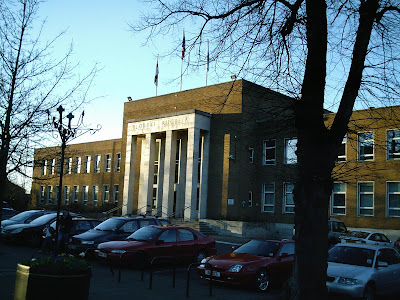
Rugby (the picture shows Rugby Town Hall) was quite a long way from the station, and although we did not spend much time admiring the cement factory the town was pleasant if a little ordinary. Rugby is home to a large public school (US Private school) where the game of Rugby was invented, when William Webb-Ellis picked up the football and ran with it, no doubt being rugby tackled as he did so. The town museum is rather sparse but the Art Gallery contained an amusing exhibition of photographs and an installation of electronic projections that I don't think any of us 'got'. The museum contained exhibits related to Roman Rugby and social history (more interesting) including memorabilia relating to British Thomson-Houston, an electrical engineering firm which I think made generators and light bulbs amongst other things.

There was a large and delapidated coöp department store and smaller electrical shop and the usual town facilities although not much for a town of its size.

27 January, 2007

The Chislehurst Caves

I billed it as a mystery tour but I knew where we were going. Chislehurst has ancient chalk workings from Roman times and possibly before. I suppose that is the origin of the name Chislehurst where they got out their chisels to cut chalk. These chalk workings are extensive: around 20 subterranean miles and are entirely man made. The Guide knew his subject and was pleasant and accommodating. Me and Mark were the only people on the 11 o’clock tour and we clutched our hurricane lamps tightly as we wandered in the darkness. There was a reputed Druid altar where the guide said boys were sacrificed but he also said he thought it fanciful as it was just the remains of ancient chalk workings. In the First World War, it was used as an auxiliary ammunition dump for the Royal Arsenal (not the coöp this time). In the 1930s it was used by the current owners, Kent Mushrooms Ltd, for – guess what – growing mushrooms. But the caverns came into their own during the Second World War as a deep level shelter. For 1d a night or 6d per week you could have a cosy alcove with a bunk bed safe from the bombs and shells. It is unusual to think of such a troglodyte existence now but it must have been welcome then. The war brought with it a church, that remains consecrated to this day, a cinema, a hospital, Citizens Advice Bureau, extensive toilet facilities, a canteen and ventilation fans. After the war the caves were used for gigs with rock bands, as they were unsuitable for mushroom growing after use as shelters as mould had got in. There is a stage there for this use. The caves are also used for fantasy games. There is a modern carving on the wall, showing Canary Wharf and river monsters, there are also the faces of Winston Churchill, Mussolini and Hitler.
The caves have a great echo, demonstrated by banging a diesel tank with a rubber mallet. All in all it was a great morning out. No pictures though, it was too dark!