05 May, 2009

Lewes in Sussex

Once the home to Thomas Paine, who I have seen described as little more than an 18th Century Trotsky, I visited Lewes to get beyond Brighton for a time, although my evening was spent in Brighton.

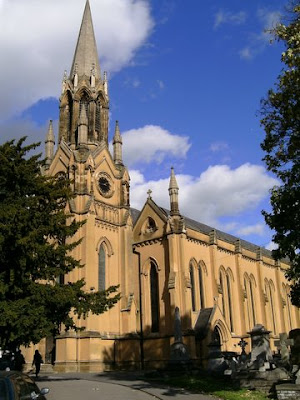
Starting at the Church of St Anne, I had a cup of coffee with the Rector, who showed me round his beautiful church, with anchorite's cell. A very pleasant one.

There are some fine bookshops in Lewes but no self guided walk, which the tourist people would do well to rectify as the town does not give up its treasures easily.

Lewes is the county town of Sussex with courts as well. There were protestant martyrs burnt there too, and every year the bonfire societies burn an efigy of some folk devil, which always used to be the pope but not so much these days.

The Sussex Archeological Trust owns Anne of Cleves House in Southover, a suburb of Lewes and uses it to display their collection of archeological and folk relics. It's good and has some enjoyable exhibits and gardens. Anne of Cleves never lived there though.
From Travels around London

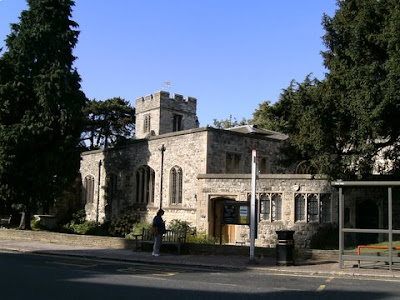
Another suburb of Lewes has this old church (below) with all kinds of relics including an Elizabethan Royal Arms in plaster on the wall.

From Travels around London


From Travels around London


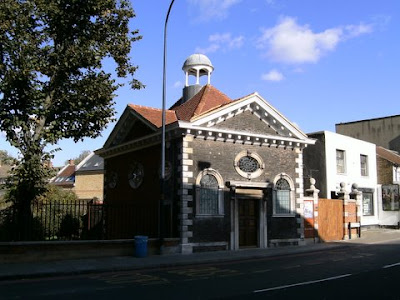
The Bloomsbury set liked to live in and near Lewes in all their sexually complicated lives. This round house was once lived in by them - it is the base of a Sussex windmill.

From Travels around London


From Travels around London

08 April, 2009

Shoreditch

A visit to an early LCC housing scheme.

Built to house slum dwellers from the notorious Jago the estate at Arnold gardens was built with a mound of refuse converted into a park with a bandstand to save disposal costs.

From Travels around London


The buildings have generally stood the test of time and skimped maintenance.
From Travels around London

04 April, 2009

Chislehurst

Chislehurst is a village of two parts, just outside the London Postcode area but not outside greater London. One part has a Sainsburys and is a bit downmarket, but cross the common and the shops become posher and the houses bigger- very big in many cases!
From Travels around London

From Travels around London


The church of St Nicholas was open when I called, with a tapestry of shields of the other parishes that had been formed from parts of the parish when that area became more built up. The rood screen came from the 15th century and the tomb of Thomas Walshingham was broken into in the 20th Century by Calvin Hoffman in the hope that the original manuscripts of Shakespeare would be there. This is one of the wierder aspects of an interesting book: grave goods were extremely uncommon during Elizabethan times....

The church is built of knapped flint and the Walsingham chapel contains Tomas Walsingham's tomb.
From Travels around London

28 February, 2009

The shattered decanter by D H (Bert) Lawrence

Auntie Chris sat in the drawing room at Eastwood Hall Hotel and Conference Centre.
From Travels around London

The hotel was in the very heart of the east midlands mining country that was once home to D H Lawrence from his birth until he could manage to escape. The hall nestled under the old slagheap like a child its mother, the village stood at the top of the valley the hills covered in four square brick houses that had once housed the coal miners – attracted by hard work and low wages to populate this village. Lawrence had been born half way up the wall of one of these houses according to a plaque present thereon.
From Travels around London

Eastwood Hall Hotel and Conference Centre was the scene for the drama that was about to play itself out and an important gathering had come there to debate tactics and strategy for the Coöp. Men, ay, and women too had come from throughout the country to be present at the gathering and that there was any love between them none would have acknowledged although they were held in much deeper bonds than mere love could provide. Some of them were brutal in speech but never coarse in manner.

Eastwood Hall Hotel and Conference Centre was by far the biggest house in the village, having over 300 bedrooms, but was set in a valley and so did not command it. The D H Lawrence heritage centre, that place of enlightenment and education, was in a more commanding position opposite the hall, and in there one could, if one were so inclined, learn what there was to know about the Lawrence family. It was even the scene of many a village wedding as it housed the registry office; all those who went through that door suffered the terrors of the damned on those occasions.
From Travels around London

In a commanding position in the high street were the Coöp stores, where villagers could shop for their groceries, electrical goods both brown and white and home furnishings. A special department catered for the villagers travel needs, and it was this department that was well frequented. The Coöp men and women had visited the stores and found them to be good. They had returned to the hall and told their friends and comrades that flannel singlets could be obtained at half price. Some of the coöperators made their way to the library, set in a square with a millennium clock and opposite an inn where the village men folk gathered to drink their ale. The clock had been paid for in part by the Midlands Coöperative Society and it showed the time to the staff in the library. There was an important DH Lawrence collection in the library under lock and key. These are not books to give your servant after all. No, the serving wench would more desire Dan Brown’s DaVinci Code or something by Catherine Cookson if she were elderly. Outside the library a modern sculpture celebrated, yet again, the one son of the village to have achieved worldwide (in)fame(y). A blue line on the pavement connected places associated with this man phoenix who had brought such prosperity to the village people.
From Travels around London

DHL's Childhood home

The conference went on in its interminable fashion with speakers both great and good. Delegates repaired to the swimming pool when it all became too much and there in the grinning water, steam room and sauna dripped away their cares until they could return to the hall refreshed and ready to debate some more.
‘What’s for dinner?’ I asked of one of the delegates, who said that she didn’t know, but thought as it had been chicken on Friday night it would be beef tonight.
‘Aye lass, ‘appen that’ll be right. Chicken follows beef as sure as Sunday follows Saturday.’

There was to be a presentation that evening at the dinner that night but the beef was not on the menu, instead pork was served to the general consternation.

After dinner the presentations were made: Auntie Chris was presented with a crystal decanter by the members of the Coöp, for having been for many, many years a stalwart in the Coöperative service. This was her just reward for the many years of hard work for the society that showed in her careworn face. The hard work also showed. She was now about to take a well earned retirement and the conference was to be her swan song. The secretary had called her name, holding the decanter in his hand. Chris collected it from the Secretary and stepped down from the stage to the applause of her comrades, colleagues and fellow coöperators depending on their persuasion. A turn to greet a fellow and oh! a slip, and the decanter lay shattered on the dining room floor.

27 February, 2009

Nottingham

A visit to Nottingham, home of lace and er that's it really. There are two interesting churches that I visited in the town St Peter and St Mary, St Mary has a 500 year old porch and St Peter has a modern tryptich and workers window that was paid for by subscriptions from trade unions and workers organisations.
From Travels around London


From Travels around London


Nottingham is also home to the legend of Robin Hood who actually came from Wakefield. He gathered a band of outlaws about him when the Sherrif of Nottingham (the office still exists) would not give him maid Marion's hand in marriage. I think there's rather more to it than that as the Sherrif is responsible for the administrtion of justice including collecting debts. Nevertheless Robin Hood and his merry men camped out in Sherwood Forrest wearing lincolngreen they stole from a merchant.

From Travels around London

Hmm. Alas the legends are really just that. There's no record of Robin Hood or his band of merry men. It's probably just a pagan survival - green men, fairys etc., but it is a good story especially when you get to the redistributive robbery.

Nottingham has a castle and a fairly grand railway station. It has some interesting shops. I was only there for half a day so not much exploring done.

22 February, 2009

George Lansbury celebrations

George Lansbury, an honest politician.

Events to celebrate the life of George Lansbury, Pauper Guardian, LCC Councillor, Poplar Borough Councillor, MP, cabinet minister, Brixton prisoner and leader of the Labour Party (this one by default). Diamond Geezer has blogged in depth about him, so I’ll blog about the walk. A large crowd had gathered outside Bow Road Tube station including some of my Coöperative friends from Hertfordshire and Essex but not a friend from Tower Hamlets who claimed to have been distracted by a tall… but we won’t go into that. Four groups led off to St Clements Hospital, the former City workhouse, to introduce Lansbury as a Pauper Guardian and how he uncovered corruption in the workhouse, next off to see some other sites less well connected, then the site of Lansbury’s house destroyed by a bomb in 1944 and now the site of a block of council flats and a memorial garden. Past the former Poplar Town Hall and the statue of Gladstone paid for by a deduction from the wages of the match girls at the Brymay factory and hence with the statues hands painted red to symbolise the blood of the match girls on Gladstone’s hands. After that into Bow church an old building for some tea and cakes. Many thanks to the man who pointed out the squirrel in the stained glass east window.

The Memorial service was also held in Bow Church and although my companion was impatient to get away to the hell hole of a tiny ‘theatre’ bar he frequents, the singing and the preaching by Ken Leach were excellent, although Bunyan’s good masculine words were mangled and ‘He who would true valour see’ was a curious hybrid of Dearmer and Bunyan but not the usual namby pamby Dearmer. The Lansbury family were out in force although not Miss Angela Lansbury who was playing Madame Arcarti on Broadway. One professor stated that he had been inspired by Lansbury to give up his riches, his big house with two cars to live modestly in a poor district. I’m all for professors living where they want to but of course all the people who do live in the poor district by necessity would, should they come into a professor’s wealth, move out to a better district and buy two cars. I know I would!

From Travels around London

21 February, 2009

East Ham - it is all sh*t!

A visit to the far reaches of the District line and the borough of New Ham an amalgam of East Ham and West Ham. I stuck to the East Ham side. And it really is horrible. I went into the vast Carnegie Library. The fiction section downstairs had a lot of books although mostly in foreign languages the information section upstairs was a vast barn with three, yes three shelves of books. Even in Barking I saw more books than that. There was nothing about the history of the borough, the topography or anything like that so I came away at a loss. The vast heritage of one of the county boroughs of Essex reduced to nothing. I made my way to the scrubby grassy park. The library promised me a tree trail – No 1. London Plane, No 2. London Plane etc. On the way to the park a stoned youth asked me where Newham College was. As it was obvious that it was opposite the library away from the direction he was going I pointed towards it and said “There it is”. He just kept walking away from it in some dope induced dream of his own. Why he would want to go there on a Saturday I could not understand.

The picture shows the public mortuary – I’d rather be in there than living in East Ham.

From Travels around London

08 February, 2009

Birmingham and Braunston

Another visit to the Canal Boat show at Braunston in the snow. I went with Phil and we had a ride on a narrow boat specially equipped for ice breaking.

From canals and waterways

02 February, 2009

the King Stone Upon Thames

Kingston is home to the stone on which the Saxon Kings were crowned. It stands outside the Guildhall. The Church (All Saints) was serving tea, coffee and cake to my companion's relief, and had some old brass and a wall painting of St Blaize with carding comb and pastoral staff.

The museum is fairly small but has some curious exhibits telling the story of Kingston through the ages.


From Travels around London

The Cleve Almshouses


From Travels around London

The Lovekyn chapel


From Travels around London

Modern sculpture

22 January, 2009

Tonbridge

Tonbridge is a small and unimpressive town on the Medway in Kent.
From Travels around London

There are some old black and white houses including an old inn, the ragged remains of an old castle to defend the medway- no more than a gatehouse - and an old church which is only open in the mornings, but probably this Trustee Savings Bank mural is much more threatened with destruction.
From Travels around London

05 January, 2009

Bow and Stepney - it's not all sh*t

But there is some nasty anti-Semitism. A new year’s walk around Bow and Stepney, omitting Whitechapel and focussed on the Bow Road. I made the mistake of leaving the DLR – London Underground up the swannee again – at Bow Church, Walking to Bow Road and travelling to Bromley By Bow which is almost going in a full circle.
From Travels around London

First stop St Mary’s Church in Bow opposite a pub that has become a mosque. The church is almost 700 years old, and the sepcentenery just misses the big sporting event that will marr HM the Queen’s Diamond Jubilee. The church has always been in the middle of the road in what is now a coffin shaped churchyard. Outside the churchyard a statue of William Ewart Gladstone with red paint on his hands presides over a (closed) public lavatory. The red paint symbolises that the matchgirls in the Bryant and May factory paid for the statue in blood

From Travels around London


From Travels around London


After that it was down the road to Poplar’s former Town Hall. Poplar was where the councillors, including Angela Lansbury’s grandfather George, were imprisoned for withholding the county rate from the LCC. Council meetings had to be held in Brixton prison. The town hall was opened in 1938 and has art works by David Evans including the two pictured here. These include sculptures of the builders trade and a mosaic representation of the work of the borough. Even though the mosaics are sadly neglected they appear to have stood the test of time.
From Travels around London

Next up, a park on a bridge crossing the busy Bow Road. This is a fairly recent project that gives a wave of green all up through the East End of London and links Victoria park with other open green spaces.

From Travels around London


From Travels around London


Just beyond the park is the people’s palace, for the education and delight of east end residents. I very much doubt that any of them, including the inhabitants of these flats opposite see inside the place now it has become part of Queen Mary College of London University. The middle classes appropriating the people’s charities for themselves. The Chapel of Queen Mary College is quite pleasant though – it is in the round.
From Travels around London

From Travels around London


The area near Stepney Green has the old trinity almshouses founded in the 17th century by Trinity House. Again these are rightly private but an oasis of calm dignity on the Mile End Road. General Booth of the Salvation Army began his work with London’s poor here and there are two statues to him – one a rather undignified one of him preaching and the other a dignified bust.

Stepney was once home to a strong community of Jews and their monuments are around. However the current inhabitants (gentiles all) were giving me filthy looks as I took pictures of that aspect of east end heritage, and one fountain commemorating someone called Montifiore, who had done work to benefit the community had been nastily defaced – and nobody had cleaned it off. Anti-semitism is alive and well - particularly among certain religious groups from the Indian sub continent.

A clock also commemorates a former mayor of Poplar and flowers were blooming here!

Stepney church of St Dunstan was locked when I called but is an oranges and lemons church where I have rung the bells.
From Travels around London


From Travels around London


Walking down to Limehouse I passed the old public hall with a very exuberant door, and finished at the gate to Limehouse Church of St Anne, which prevented access to the churchyard.

Cold but bright.

From Travels around London

24 December, 2008

A Christmas message from me and Dulwich Park

May peace prevail on earth!

Have a blessed and peaceful Christmas.

From Travels around London

Dulwich: G*ds Gift.

A Christmas eve visit to one of the far reaches of the borough I live in – although you wouldn’t think it was the same one. Several posts ago I visited Margaret Thatcher’s former constituency – this time I visit her [former?] home.

Dulwich is a suburb that pretends it is a village. I set out from East Dulwich Station early in the morning and started walking down Lordship Lane, Dulwich’s main drag. It being Christmas eve, people were out doing their last minute shopping and in particular there was a very long queue, 3 shops long in fact, outside the organic free range butcher and poulterer. This I thought typical of Dulwich. Lordship lane winds its way up the hill to come to the part of Dulwich where there is a library and the Dulwich Park. The fledgling LCC laid out Dulwich Park in 1889 after a public campaign against the governors of Dulwich College who owned it. Considering the increase in values of their property that the park has guaranteed at no cost to the Governors this seemed to be a remarkably short sighted resistance. Never mind the park is now preserved for ever with a lake, sculpture by Barbara Hepworth, bicycle hire to imperil life and limb, and rivulets, a cascade and old oak trees. The Lordship Lane end of the park has a nice, but ordinary development of houses: the Dulwich Village end arrives in a different world.

The Dulwich College Estate totals three square miles and is the largest single estate in London, its profits dedicated to the education of the wealthy children of wealthy parents and charitable causes. The estate is the gift of Edward Alleyn,
From Travels around London
(not G*d – although it bears the motto G*ds gift) a friend of Shakespeare, an actor, theatre proprietor and keeper of the Kings Bears. He died without issue and left a college for 12 poor scholars and an almshouse for 16 old people, the master of both Alleyn insisted should bear his name. There is also a girls school in Bermondsey named until recently, when it was sold to the Harris family, Alleyn’s school.

The village is pretty and has curious finger posts to point the way. The little grammar school survives as an estate office,
From Travels around London
and the almshouse block still houses old people as intended, with their chapel open to all to worship with them on Sundays. In the village is St Barnabas’s Church a very modern edifice with a slender and transparent spire. This church is beautiful.
From Travels around London


Dulwich College also owns a small art gallery (admission charged), which is the nucleus of an art collection ordered by King Stanislaus of Poland for a polish national gallery. When the Kingdom of Poland was broken up there was nowhere to send the collection so it came to Dulwich via a quite circuitous route and is housed, together with the bodies of its founders, in the first purpose built picture gallery which was designed by Sir John Soane. The gallery was closed today.
From Travels around London


The buildings of Dulwich College, which can now hold 800 boys (hopefully 12 of them are poor, but I suspect that's not the case), are a little way out of the village on a toll road, which costs £1 for cars but is free if you’re walking.
From Travels around London

From Travels around London

From Travels around London

Walking away from the college towards west Dulwich I noticed a large church set up on a hill for all to see. This was All Saints Church that has recently been rebuilt after a fire. I didn’t go into the church because a baptism was taking place but the fire had destroyed much of the Victoriana and left the church much more dignified and open. The acoustics from the new choir gallery must be fantastic. The new communion table and lectern are simple wooden forms and there is a charred black cross in the apse. They still are paying for the work so you may wish to donate. Their website is http://www.all-saints.org.uk/

After that it was time to come back home again, the queue had diminished in the organic free range butcher and poulterer so it was now only one person out of the door.

22 November, 2008

Brentford and Chiswick

I went to Brentford and Chiswick - they were shut!

Brentford is the county town of Middlesex until the county ceased to exist in 1965. However the County Hall, the Middlesex Guildhall, was and still is in Parliament Square Westminster, so it does not have grand civic buildings to captivate the eye.

Leaving the station I came to a civic group comprising a library and public baths. The Public baths foundation stone was covered in graffiti but the baths seemed to have been declared open in the 1890s. Needless to say they were closed and boarded up now. The Brentford library was a shadow of what it had been but was warm and had some books on the subject of Brentford although not very many. Turning off the street where the library was I came to The Butts, a village green of eighteenth century houses, where archers once practiced although long before the eighteenth century. More a car park now than a village green and it was hard to imagine a cattle
market there as there once was. The Butts led into the high street. There were very few shops, people in Brentford seem to want Fibreglass - really there was a fibreglass shop- furniture new and secondhand and tyres. Most of the other shops were shut - on Saturday morning too!

From Travels around London


St Lawrences church at the top of the High Street was surrounded by an insecurity fence and looking very delapidated when I called. The Grand Union Canal joins the River Brent here, many miles from Braunston and there is a guaging lock where tolls were charged using a special guage to ascertain how low the boat was in the water. Needless to say the historical display about this was closed, with no signs of opening hours.
From Travels around London


George III used to drive slowly through the town's high street because it reminded him of Hanover. Whether it would remind anyone of Hanover now would depend on whether Hanover has a row of 1960s shops, a Somerfield supermarket and a block or three of flats, oh and most shops deserted or closed on a saturday morning. I decided to hasten a carriage to Chiswick and took a bus along the rural looking thames past an old church with eighteenth century school and the very modern looking musical museum. In Chiswick there were plenty of shops including a second hand bookshop. It is also rather near Bedford Park. Bedford Park is the first Garden Suburb, laid out by Norman Shaw with its church (St Michael and All Angels) and its inn, the Tabard all adjacent to the village green. Although Turnham Green is the station nearest Bedford Park, Turnham green is actually north of Chiswick. There are some long streets in Chiswick, and I could not find Chiswick church that must be a lot older than Christ Church Turnham Green.

From Travels around London

Chiswick contains Chiswick House and grounds and Hogarth's House where the painter of scenes such as the Rake's Progress lived and worked. A "County of Middlesex" plaque marks where he lived and worked but the house is closed to the public until 2009, with no warning on the leaflets displayed in the library. Rubbish service from Hounslow Council. As I couldn't see Hogarth's House I decided to go and see Chiswick House. This was also undergoing refurbishment, including most of the park, until 2010. Again no indication until arrival. To get to both these buildings it is necessary to cross the Westway, a major motorway out of London - thankfully by way of a subway.

From Travels around London

This bizarre house was near the Westway but in a much quieter road.

Naturally I was frustrated at this point and caught a bus to go on to another appointment. I should have stayed on the bus to Turnham Green Station where there were more trains, instead of Chiswick Park.

Brentford and Chiswick - don't bother until 2010!

28 October, 2008

Personchester

A good post about Personchester for once. The Art Gallery was showing an exhibition of preraphaelite Christian art. The originals of the ones I saw at Lee!

http://blog.standonline.org.uk/italker/files/2007/10/the-light-of-the-world-print-c10081280.jpeg

20 October, 2008

Lee, on the outskirts of Lewisham

Lee nestles between Lewisham and Blackheath, and can be said to be fairly well to do. Starting at the Old churchyard of St Margaret of Antioch a heritage trail leads to the ice house in Manor House Park. The church of St Margaret of Antioch has clayton and bell stained class and wallpaintings, and an exhibition of christian art reproductions. Well worth a visit.
From Travels around London

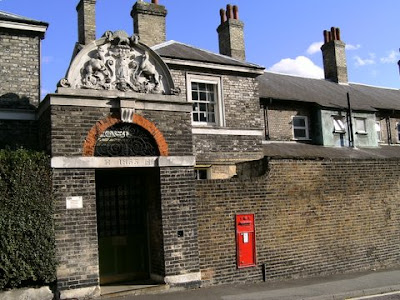
the Merchant Taylors and Boone's almshouses have been providing care for old people for 300 years since 1608 including a derby and joan club with a waiting list.
From Travels around London


From Travels around London

12 October, 2008

finchley and the city

A visit to the London Maze, the City of London Corporation's local history fair at the Guildhall, a new building on old foundations (i.e. it was flattened during the second world war) which was interesting in itself. The fair was less interesting although I looked at a book about london housing in the 1930s. £35 was too much to pay though.

From Travels around London


Next on the list of visits was Wesley's Chapel. This was surprisingly like a Church of England church of the 18th century, the only difference being the pulpit directly behind the holy table. The communion rails were donated by Margaret Thatcher, who was married and had her children christened in the chapel.

The Museum of Methodism in the chapel cellar was somewhat confused and confusing with each explanatory board numbered, except when they weren't, but had artefacts and paintings relating to John and Charles Wesley and methodism in general. I'm not sure I came away with a greater understanding of Methodism but it was interesting.

From Travels around London

Afterwards I had a visit to Finchley which was better than I thought it was. The Church, dedicated to St Mary, was almost as long as it was wide, with a fine timbered roof of the 1940s (again the chancel was flattened during the second world war). The church was of 13th century origin but altered in the 19th and 20th centuries. The main drag of Finchley and the housing was pleasant. This was Margaret Thatcher's constituency

From Travels around London
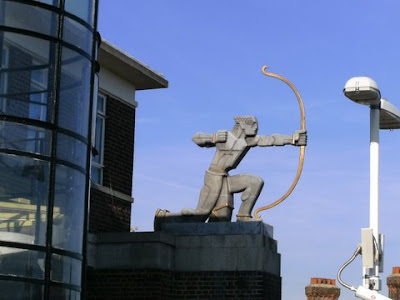
The finchley archer at East Finchley symbolyses rapid transport to central London. Yeah right.