03 May, 2010

Faversham town of the two brewers.

I've been to Faversham before but only seen the former co-op superstore and the inside of the Chimney Boy Pub there so a bank holiday visit was in order, especially as the man who invented bank holidays lies in Kent soil in Farnborough (really the London Borough of Bromley). Faversham is an old market town with an old covered market and guildhall. Even though the guildhall was rebuilt in the 19th century it still has a look of the meadieval market it once was. there are lots of old black and white buildings, although these days they are more dark brown and mustard yellow, the fashion having moved on after mock tudor debased it.

There was this marvellous door with the Kent shield above.

One connection with home is that the bricks for the viaduct that runs through my bit of Saaf London were made in Faversham, and sent to london on barges from the port.

I visited the antique shops that were quartered there.
The Church was rebuilt in the Gothic style in the 18th century but in a half hearted way. The clerestory windows are pointed outside but on the inside they are lunettes. The church has a proper Georgian ceiling and not left open to the tiles like the Victorians would have done.

Altogether the church was a good one with the remains of a meadieval painted pillar, presumably covered up with something when the iconoclasts came to call. The wooden treasury was out of view, as I suppose a treasury should be if it is to be effective.

After church it was time to have lunch in one of the few pubs serving food on a bank holiday washed down with some of the local brew made in the town. Suitably fortified I made my way to the museum, run with great enthusiasm by the local heritage society. The museum had a great deal of interactive exhibits in the form of the staff and one was forced to interact with them, although I would have preferred to reflect on the exhibits myself... They were helpful though
After seeing the Strowger telephone exchange it was time to wander and take pics for the other blog, I went past the substantial Almshouses towards the Chart Gunpowder Mills. Faversham was a major producer of gunpowder until the end of the first world war when it was nationalised. Again run by the heritage society I chatted with the attendant about almost anything but gunpowder.

On the way home called at Sittingbourne.

25 April, 2010

Mitcham

I've not been to Mitcham before and a flying visit on a dull day did not show the village at its best, but there was a church and a school and an almshouse, so it might be worthwhile to go back.

18 April, 2010

Woodhouse and Kells, Whitehaven, Cumbria

A relaxing visit to Whitehaven in Cumbria. This is a former coaling port that has invested in its quayside where in 1788 Paul Jones failed to capture the town and in his attempt to invade England from America. He was a local man and there are somewhat mixed feelings towards him in the town. The aristocratic developers of Whitehaven were the Earls of Lonsdale the Lowther family, who built the town from 9 cottages to 2000 people, mostly working in coal mines for export to Ireland. This is explained in the Beacon Museum. This museum tells the story of Whitehaven and its people up to the present day and is pleasant with a viewing gallery.
The Church of St Nicholas, patron of fishermen, was burnt down in a fire a few years ago, but a cafe with worship space has arisen out of the ashes with a beautiful garden with a memorial to those who died in the mining industry. The cafe was very pleasant and raises funds for the parish united with St James in the Parish of Whitehaven.

The jetties are now available to stroll on and are pleasant on a fine day of which I had several while there.


BestMate and I stayed at the Mansion, a pleasant hotel in Woodhouse Estate immediately adjacent to Kells, both suburbs of this small town. In Kells there was a mining museum with a working winding engine and one that was awaiting restoration. Most interesting and with its friendly custodian BestMate and I had almost a guided tour. The miners life was hard and alleviated by the 'pleasures' of drink, but also by sport, animals, gardening and other traditional passtimes.
The Church at Kells occupies a central place on the Woodhouse Estate.


All in all a relaxing place to be.

10 April, 2010

Creepy Crawley - it wasn't though.

Another in my series on the New towns. Crawley, designated a new town in 1947 is in West Sussex and is unlike other new towns in that the town centre is built around the core of an old town with its 13th century church dedicated to St John the Baptist.

The main high street had a range of buildings dating from every period in history although it must be said they were mostly pubs!
The new town centre had a bandstand bought by the Development Corporation from Gatwick Racecourse. This provides a focal point - as you can see the day I was there was gorgeous!

Crawley is a bustling town although one curious feature is that shops have two street frontages, each on a street of importance and one can cut through the shops if one wishes.
The library is new and excellent. It was a good day out.

28 March, 2010

Kingswood House and Crystal Palace

A visit to Southwark's only grade II listed building. Except it was closed today being Sunday.
Kingswood House is set in the middle of an estate of 1940s council houses and flats and was once a manor house set in fields near the Dulwich Estate.

21 March, 2010

The pocket handkerchief parks of Hatcham

A Sunday walk around Deptford and New Cross (which is really called Hatcham)

I started out at the rather bleak Deptford Park although this has been improved recently with a sculpture and a rose garden (no roses yet but we live in hope) and went into Folkstone Gardens. There was some criminal activity in the park but that didn't stop me, and I took a look at the pond. I noticed one of the rocks had a model terrapin on it, which I thought a somewhat odd choice for an ornament. Imagine my surprise when it saw me and crawled down the rock and into the water! No picture of course, but I hope I havent made it an endangered species.
After that went to Fordham park (just a piece of grassed waste ground really on the approach to Hatcham, and the hillside park called Telegraph Hill. This was an Admiralty semaphore signalling station when it was farmland but that fell into disuse with the advent of the electric telegraph. The views to London are amazing. It's a 10 acre park on a very awkward site but crams in a lake, a play area, tennis courts (free) toilets and office, and appears quite well looked after. There was a guided tour ongoing as I arrived.
Most of the land is owned by the Haberdashers Company (E.G. Haberdashers Aske Hatcham School) and this plaque appears on their property.

20 March, 2010

Barnet: fair

Even though it was wet. Barnet is at the end of the Northern Line and the station is called High Barnet although it really should be called Chipping Barnet, as that is the name of the town. The same happens at Chipping Ongar. I think London Underground somehow think that the word 'chipping' isn't very nice. That aside it was a wet day so I just did the town. I missed the old alms houses and the museum (as it takes a lunch break) but the church was open.
.
The reredos appeared to be victorian but there was a good modern stained glass window in the tower that looks much the same as it did in 1940 when the Kings England guide to Herts was published. The Folk Museum at East barnet is just a memory though - I once looked for it and found it derelict.
I did notice a lot of senility on the street and in the shops - most disturbing. Perhaps the proximity of the former Colney Hatch Lunatic Asylum (Friern Barnet Hospital) now being turned like everything else into yuppie hutches has led to this madness. There were about 5 people obviously in mental distress in Barnet High Street alone.

I moved on to North Finchley and Friern Barnet where part of the hospital had not had anything done to it. I suppose nobody wants to live in a turrett..

I then went home via a friend in Hornsey.

14 March, 2010

Maidstone, Kent

I was debating whether to go to Aylesbury again but decided to go to Maidstone instead. I've been before but not blogged about it before so that swayed me. Maidstone is the seat of the County of Kent with the kent County Hall there.

When I was there before the museum was robbed while I was in it. (Wasn't me guv). I had been in a small gallery and when I went back into the gallery one of the cases was smashed. I noticed that it had been repaired on this visit but it is disconcerting that a museum could be robbed while one is present.

Maidstone has a traffic problem and some of Kent's finest old buildings. The Carriage museum is housed in the Archbishop's old stables, these have been built for 600 years or so.
The Archbishop's palace has been turned into the town registry office and lies, as is appropriate, next to All Saints Church. The palace was home to the Archbishops of Canterbury from the reign of King John to Henry VIII. Falling into decay it was rescued for Queen Victoria's diamond jubilee.

The Collegiate church was surrounded by scaffolding when I called so I couldn't get a picture, but the original miseriecords were present for the college of 24 canons who were to pray for and educate the people. they had beautiful old carving rubbed smooth by the bottoms over 6 centuries although I noticed one chorister had the 21st century habit of leaving chewing gum on the ancient woodwork. The church is a wonder, and the ruined college next door picturesque.

Andrew Broughton the regicide lived in Maidstone, and may have known the old Tudor Chillington Manor, the town museum.
William Hazlitt also lived in Maidstone and the library had some of his books - in the discarded stock sale!

07 March, 2010

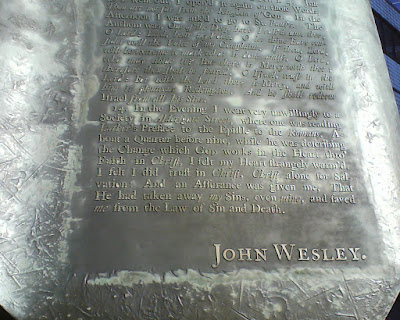
The Aldersgate Flame

John Wesley's conversion place where he felt his heart strangely warmed after a meeting of a society. The same thing happened to me after church one day, but then I discovered I'd spilled a cup of tea down my front!

Southend and Basildon

I've posted about Southend before and the place hasn't changed much since then, here is a picture of the Estuary front.

On the way back from Southend I stopped at Basildon, another new town. I’ve written elsewhere about Harlow and it is interesting to compare the two. Harlow dates from 1947 and Basildon from 1948 but they seem to be worlds apart, although this may be just familiarity. Basildon seems to bustle more than Harlow but has fewer artworks in the town. The oldest sculpture is on the side of ‘Freedom House’ (what a name) and is an abstract. Untitled, it is by A J Poole and was installed in 1957.

The sculpture of a mother and child in the fountain is interesting and is opposite the former co-operative store now occupied by Primark (as at Stevenage). The fountain was installed in 1962 and is black as coal. In the background is Brooke House also built in 1962, (did the council raid the housing account to pay for it one wonders?) a block of flats named after a Housing minister and designed by Sir Basil Spence. The only bit I could see was the lift lobby which was lined with marble and mosaic. A fitting setting for working class housing.


The Church of St Martin of Tours (Church of England of course) claims on its website that the church gardens make a pleasant place to sit, as well they might if they were not locked away behind 5 foot iron bars. The gardens have fountains playing round the side chapel of the church, although difficult to photograph. The church itself is attractive with a sculpture of Jesus over the door waiting in welcome and stained glass windows up to head height in the walls giving a floating impression.

The detatched modern campanile contains an 11cwt ring of 8 bells including the tenor cast in the 15th century and treble and second cast in 1997. The campanile was opened by the queen on my 32nd birthday


The library was quite well stocked with local history books although the books argued which shop had been the former co-op. I could not find out if it had been London Co-op Society, which was most likely, or Chelmsford Star Co-op which was the geographical best fit. There are a good few charity shops in Basildon and I bought a jug (£5 marked down from £15 although I even thought £5 was a little steep – cancer research are always pricey). It was dated 1943 and just as I got it home I dropped it and chipped it – blast! There were the usual pound shops but there was a Debenhams Department store.

There’s a very good train service from Basildon to Fenchurch Street.

27 February, 2010

Brentwood, Essex

Brentwood is near to the Kelvedon Hatch Secret Nuclear Bunker, and is actually a bit like BrentFORD. Perhaps it's psychogeography. I went to Brentwood as I was determined to get good value from my Essex visit, where I was lulled to sleep by a one eye grey story.

Notwithstanding the rain Brentwood doesn't give up its secrets easily. The town is a bit far from the Railway Station although a sort of town has grown near it. They do have a martyr called William Hunter who was burned at the stake at the age of 19 for the heinous crime of reading the scriptures, which he would not give up even for ready money. His memorial obelisk was restored in 1910 after the monument was damaged by fire. I wonder if there's more to that than meets the eye? Probably not, although Brentwood has a Roman Catholic cathedral, although you won't see it on here in accordance with usual policy.

The Village green in Brentwood is called Shenfield Common and this drinking fountain was given by two benefactors - husband and wife. I had a Mr Toby pie and pint special in the local pub which filled a gap if nothing else, but would have preferred the drinking fountain to be operational.

The real church of Brentwood is 19th century huge and I'm sure its congregation love it. It's not particularly photogenic though so the only church picture is going to be the ruined pilgrimage chapel of St Thomas a Beckett, now merely a ruin

There is no guided tour of the town for visitors, an ommission that somebody connected with the civic pride should correct.
Civic pride is manifest in this sculpture that greets people coming up from the station. It was however the last I saw of Brentwood besides a rather damp, smelly secondhand bookshop.

21 February, 2010

Getting in touch with my North (London) side - Canonbury and Crouch Hill.

A sunny saturday for once so time to go out again - I had some Islington Society trail leaflets and what better day to go out and use them.

There is a story by Alice Bower called 'Shanaya meets a northsider' where Shanaya a girl from Peckham is always told by her mother to 'Beware the fiendish northsider so sly' so I was taking precautions. I had my A-z and the trail leaflets. Starting off at Highbury corner - note to Islington Society please start your trails at a tube station- I picked up the first trail through canonbury via an ordinary street of houses with a 1970s school being demolished and replaced by one clad with wood. The trail led into Petherton Road with the New River (remember?) running underneath the generous green space in the middle.

The next bit of any note was Newington Green with a Unitarian chapel where Mary Wolstencroft (also known as Mary Shelley) had worshipped.

Also on the other side of the green was what the Islington Society called London's oldest surviving brick terrace - I suppose that at least they're Islington's oldest.

Newington Green was rather nice with 'treasures' planted around which were supposed to give up a secret when pressed. The mechanism seemed not to work anymore.
The next bit followed the New River and led eventually to Canonbury Tower
Formerly part of the Canonbury manor house the tower dated from the 16th century - and it looked like it did. A brief excursion to Canonbury Square (where Eric Blair - Tony's Grandfather also known as George Orwell lived) and the walk was done.

The next trail led from the horrors of Finsbury Park station to the almost delights of Crouch Hill.
This interesting looking church was one of the highlights of a dull urban walk

The Islington Society pointed out some award winning gardens on one of the streets and I thought typical Islington. They've been given an award because their gardening's 'edgy' but really both gardens were simply a mess.
The other point of interest was the Old Dairy public house - not surprisingly in an old dairy. There are stucco panels depicting what are now historic scenes of dairy farming and milk production.
The trail led to crouch hill and then petered out.
I couldn't be bothered to do the next one although I looked at Hornsey Road Baths (now flats)with this evocative sign (restorred)

I then decided to go shopping in the Holloway Road.

07 February, 2010

muddy foggy day in the clent hills

After Northamptonshire yesterday it was the turn of Worcestershire today. The Clent hills is a popular spot for walkers even on a borderline rainy day like today. The National Trust run a car park although it is easy to park elsewhere.

The hills are wooded and have four stones standing on top of them - said to be built by the Earl of Dudley who used to own the Estate.

There is even a special viewpoint
.

A very nice place indeed.

06 February, 2010

Daventry and Stoke Bruerne

Daventry is a market town in Northants right in the middle of hunting country, there is a memorial to a member of a hunt committee in the high street. Lots of local shops and cafes with very few chains. I have to say that the cafe I went into with my friend was chaotic and they forgot our order.
The church was nice but no real time to look round as so much time wasted waiting for food that never arrived.


Daventry should be pronounced Danetre but nobady does thanks to the BBC who have a transmitter there, who pronounced it as it is written.

After Danetre went to Stoke Bruerne to see the National Inland Waterways museum, with canal boats. It was very nice with lots of canal impedimenta painted with roses and castles and parts of the hard life of a boatman.


We went for a walk up the canal to the Blisworth Tunnel which is just under two miles long.

We went for a walk over the top but stopped short of finding the end at that distance.