18 July, 2010

Havant and Emsworth in Hampshire.

I thought I might make it into Sussex this time but I stayed within the bounds of Hampshire. Havant is another town on a crossroads like Chichester it has North, South, East and West Streets. It even has a pallant, although there is only one here and it's called THE Pallant!
The origin of Havant is in a spring that runs south west of the churchyard, where two ancient roads crossed. In the middle ages Havant became known as a parchment producer, assisted by this and other fresh water springs, and this trade lasted until the 1930s. The treaty of Versailles was written on Havant Parchment. There is a sculpture representing leaves of parchment by this well, although I hope nobody mistakes it for a urinal.


The church contains some of the oldest things in Havant, because it has Roman bricks in the wall. Open when I called with some cheery parishioners there are lots of cobwebs adorning the upper windows, but the lower windows have some modern glass. I particularly noticed a memorial window to the sailors of HMS Havant with a battleship on it. The Church is dedicated to St Faith and is pleasing inside and out. The Chancel has some beautiful vaulting of the 13th century although the nave was renewed in the 19th century.

One of the gardens, locked when I called, contains this pretty gazebo or 'gazing place'. A great pity it was locked.


The Post Office in the town is one of the few buildings to bear the monogram of Edward VIII. The Telephone exchange at Reigate also bears his monogram. It is a reminder that all communication used to be guaranteed by the crown, and that telephones used to be under the Post Office.


Emsworth is a pretty little yachting town at the top of the Hampshire side of Chichester Harbour. The museum contained a tribute to Emsworth's most famous resident P. G. Wodehouse, the author who broadcast for the Nazis during the Second World War. I enjoyed his books when I was about twelve but the world of pig breeding aristocrats soon pales into insignificance as one grows up. People do take Wodehouse seriously though. I once read an article that analysed train times to try to find out where Blandings castle was! I always thought the thing about fiction was that you made it up. Wodehouse escaped the fate of William Joyce, even though Wodehouse actually was under allegiance to the Crown, and Joyce wasn't, but Wodehouse went to America and stayed there.

The self guided tour takes one round the town, although there is nothing of more than local importance. However the boatyard and fishermans cottages are attractive.

10 July, 2010

Horsham

Horsham is famous for Christ's Hospital but that has its own station. I called there in the afternoon and stayed until evening. Horsham hides well and the signs to direct one to the town centre via park are not always accurate. But the town is old and has some interesting artworks around.
The Registry office in the park has a sundial in fromt of it in a rather nice garden

There is also a swimming pool and gymnastic centre in the park and kinetic sculpture around the town. THis ball gradually fills up with water on the way down, releases it and begins to rise again. To the delight of kids of course!

The museum is extensive with a lot of collections with real old stuff! It's rather typically a small town museum that does not say a lot about the town's uniqueness - perhaps Horsham isn't that unique. They had also run out of self guided walk/town trail leaflets when I called.
The church was locked when I called but apparently is good inside, and genuinely old. Made from ironstone and roofed with horsham stones it looked good from the outside, alas unphotographable.
Thr road to the church was lined with old worlde cottages such as these .

Chichester - What a nice pot of tea!

Chichester is a town on the Roman pattern with streets running to all the points of the compass from a central market cross: there are North, South East and West Streets. There is also a town within a town in the Pallants, which in the south eastern quarter. These streets monitor their big brother with North South East and West Pallants. When I called the Chichester Festivities were in full swing so it was difficult to see interiors of buildings but externally some are splendid.

King Charles Stuart gazes down from the 16th Century market cross in the town.

The market has moved to a car park near the station but the cross is rich with carvings although the statue niches are empty today.

Chichester's glory is the Cathedral with its tall spire visible from the sea.

Unfortunately when I first went there was a prizegiving for the local prebendery school so I couldn't really go in, and later there was a concert in the cathedral so I saw very little of the nave and transepts, although there was a large painting of the bishops of Chichester. The treasury was open and I had a look in there at the various parish treasures including chalices and bread plates. There were many communion cups from 1568 which was the year that Chichester Diocese began the innovative practice off giving the wine to the people, previously it was reserved for the clergy alone. I reflected wryly that this should be the practice today - Perhaps that's the way round women bishops - From 2010 x diocese will be able to appoint a woman bishop - from 2011 y diocese and so on... Perhaps even one day we will have gay bishops who do not conceal it. Maybe that's a step too far (sigh). The Cathedral was filled with modern art, much of it collected by the previous bishop and included a sculpture garden, including this one - Place for a boy!
. In fact the city does well for modern Art, the Pallant House gallery, recently extended with the addition of a restaurant is a major modern art gallery in the South. Can't remember the admission charge being as steep as £8.25 last time I visited though...

There was once a priory in the town and the remains, formerly used as a guildhall are now in Priory park. Surronded by the Chichester Festivities no picture was possible. It is an accompaniment to the Chichester Museum and contains some Roman stoneware. The real guildhall is in North Street.
The museum was pleasant enough but being wound down for its closure and removal to a site opposite the library, where a Roman Baths had been found. I will look forward to this. The Library was opened by Prof. Asa Briggs while he was chancellor of Sussex University.

You may be thinking that Chichester is all art and culture, but you'd be wrong. When I last visited regularly there was an industrial meat processing plant in the middle of the Town Centre. Shippams meat paste was produced in a factory there, and stank out that part of town. When I was a child upermarkets carried shelves of this nasty teatime staple, but thankfully the market has declined since then. This may possibly be due to some extremely off the wall advertising by Messers Shippams, which did not bring the product to the minds of people but seemed to positively discourage them from buying it.

And in case you don't know what I mean, here's a link, which also explains the title of this post!

04 July, 2010

Clacton on Sea- don't bother

A trip to Clacton courtesy of a scheme whereby one can obtain cheap tickets to places. Firstly the train journey was OK although trains are infrequent and the station is not too far from the town, and very near the library which was having a booksale. I went into the Tourist Information office to ask if there was a self guided walk around the town, which there wasn't. The staff were helpful and told me that the gardens were lovely, which they were, but that there were no museums or anything like that. Clacton was founded in 1871 as a resort by somebody called Peter Bruff, so it has no aristocratic pretensions: it's a basic plebian holiday resort.

I had a look at the gardens, especially the 1920s garden

which were particularly nice, although more at their best in bright sunshine.
I also had a walk on the pier, where there were sociable urianls - arranged back to back so you could talk as if over a fence while you micturate... There weren't enough people in there to talk to.
The pier was OK with lots of rides and stuff for kids, as well as a gambling hell.

After walking through the gardens to the Martello Tower

and then walking back again the other way, looking in the charity shops (pretty poor really for a retirement place) I really had had enough of Clacton, even though Joe Longthorne was on at the Town Hall.
Pretty gardens but otherwise no interest.

01 July, 2010

Richmond and Twickenham - Strawberry Hill for ever

A stroll on a summer evening from Richmond to Strawberry Hill, after picking up some bargain antiquarian books that will help this blog when I comment on the history of London Suburbs.

Richmond is leafy and affluent - millionaires live here and they always have - with the Royal Star and Garter Home for Ex servicemen and the newly politicised-poppy factory. The British Legion have asked Nick Griffin not to wear one, so the Legion have politicised the poppy now. I walked from the centre of town along what the council call the Arcadian Thames towards the lovely Marble Hill House but was shocked to find a notice - from English Heritage of all people stating that it was the home of George II's mistress! How lacking in dignity.

There is a grotto and an ice house in the grounds

But the house itseld is the gem, although when the LCC acquired the land in 1902 for a park they did not think so - it was rather an embarrasment and it took the impetus of the second world war to at least begin the thought process that leads to restoration. The money they spent appears to be well used although the opening hours for the house are diabolical now English Heritage have their greedy paws on it.

The south front

the north front.
After Marble Hill I went on through Twickenham - Which I've already blogged about, and I decided to walk to Strawberry Hill, passing a school with this plaque on the wall commemorating the villainous MP Henry LaBouchere.

LaBouchere introduced the crimme of gross indecency - a blackmailers charter and the crime for which Oscar Wilde was prosecuted. That that nobody should be commemorated by a plaque!

I walked on to Strawberry Hill Horace Walpole's Gothick (not Go thick please) mansion. Alas it was surrounded by scaffolding and builders impedimenta.

So no good photograph of the mansion in its glory

just one of the wall.

12 June, 2010

Esher

A visit to Esher in Surrey, although I didn't go to the races at Sandown Park. I hadn't intended to set off for Esher but that's where I ended up. I intended to go to Weybridge but when I got off the train at Surbiton there was a bus waiting to take me to Esher, so that's where I went. Travelling through Hinchley Wood, which has the distinction of being 49 in the book 'Crap Towns' . This book says that Hinchley Wood 'sucks the life out of you like a mock tudor vampire' so I didn't stay to test it.

Esher is a bit different. It has some genuine old stuff as well as the racecourse with its 16th century church of St George in the care of the churches conservation trust

This little church has a family pew for the Earls of newcastle accessible only from outside the church, but with a fireplace in each of the two pews. There was also an art exhibition in the church when I called. Queen Victoria worshipped here when she was a girl.

There is a grotty grotto on the Portsmouth Road

opposite the Town Hall

The real village church built on the green is Victorian.

05 June, 2010

Broadstairs

Mr Pooter (the Diary of a Nobody) liked to spend his holidays in Broadstairs, as did Charles Dickens. One assumes that by Mr Pooter's day it was somewhat unfashionable and that if Mr Pooter liked it then there was something wrong with it. I think I can go along with that. The town certainly makes a little Dickens go a long way with plaques and busts all over the place although the main bust at Bleak House (that Dickens would have called Fort House) was covered with scaffolding when I saw it.
Never the less, it is a seaside resort with a lifeboat station dating from the 17th Century adorned with figure heads salvaged from ships.
Strolling around the bays was pleasant, even on a really busy Saturday although the crowd was rather chavvy as is often the case in Kent.

The hospitality industry also needs to learn a thing or two. Most people don't carry much cash these days and when a pub (named after the town's most famous visitor) sets a £20 limit for credit card purchases it is decidedly Pooterish!

04 June, 2010

Another visit to the Chilterns - the Chilterns Open Air Museum

Another Metropolitan Line ride, this time to Chorleywood and the Chilterns Open Air Museum. Arriving at Chorleywood with the right OS Map this time I set out to walk to the museum, it should have been about two miles by my navigating skills. Unfortunately I got a bit lost because the map was unclear. Never mind it was a beautiful day for a walk in the country. I eventually found the museum which contained all kinds of buildings salvaged from the chilterns and the environs, including a public lavatory from Caversham (they don't make them like that any more) a mission hall made of corrugated iron made by Boulton and Paul and a prefab from Amersham furnished with utility furniture.

There were other buildings too, a lot of farm buildings and a toll collector's cottage with office for collecting tolls and living accommodation (Kitchen, Bedroom, wash house and earth closet) although not very much of it.

The museum was pleasant with woodland walks and an iron age house that had been built from scratch.

I walked back to the station taking a slightly different route, the one I should have used going there which was in the shade of the Woodland Trust's Phillips Hill Wood.

03 June, 2010

Hampshire

A short holiday in Hampshire including Romsey and Winchester. Many thanks to R & J for kind hospitality!

Here is a Hampshire hog and a sculpture of King Alfred, both in Winchester.


Southampton's Ocean Village was a trendy spot to go during my college days although it never really took off, and has now died somewhat. Previously the terminal building for sea crossings, it is now a coffee shop. The lightship from Calshot Spit looks a little decrepit and forlorn.

16 May, 2010

The Old Song G.K. Chesterton


A livid sky on London
And like the iron steeds that rear
A shock of engines halted

And I knew the end was near:
And something said that far away, over the hills and far away
There came a crawling thunder and the end of all things here.
For London Bridge is broken down, broken down, broken down,
As digging lets the daylight on the suken streets of yore,
The lightning looked on London town, the broken bridge of London town.
The ending of a broken road where men shall go no more.

I saw the kings of London town,
The kings that buy and sell,
That built it up with penny loaves
And penny lies as well:

And where the streets were paved with gold the shrivelled paper
shone for gold,
The scorching light of promises that pave the streets of hell.
For penny loaves will melt away, melt away, melt away,
Mock the men that haggled in the grain they did not grow;
With hungry faces in the gate, a hundred thousand in the gate,
A thunder-flash on London and the finding of the foe.

I heard the hundred pin-makers
Slow down their racking din,
Till in the stillness men could hear
The dropping of the pin:
And somewhere men without the wall, beneath the wood, without the wall,
Had found the place where London ends and England can begin.
For pins and needles bend and break, bend and break, bend and break,
Faster than the breaking spears or the bending of the bow,
Of pagents pale in thunder-light, 'twixt thunderload and thunderlight,
The Hundreds marching on the hills in the wars of long ago.

I saw great Cobbett riding,
The horseman of the shires;
And his face was red with judgement
And a light of Luddite fires:

And south to Sussex and the sea the lights leapt up for liberty,
The trumpet of the yeomanry, the hammer of the squires;
For bars of iron rust away, rust away, rust away,
Rend before the hammer and the horseman riding in,
Crying that all men at the last, and at the worst and at the last,
Have found the place where England ends and England can begin.

His horse-hoofs go before you
Far beyond your bursting tyres;
And time is bridged behind him
And our sons are with our sires.

A trailing meteor on the Downs he rides above the rotting towns,
The Horseman of Apocalypse, the Rider of the Shires.
For London Bridge is broken down, broken down, broken down;
Blow the horn of Huntington from Scotland to the sea --
...Only flash of thunder-light, a flying dream of thunder-light,
Had shown under the shattered sky a people that were free.

15 May, 2010

A delightful 10 mile walk in the Herts Chilterns. Tring, Aldbury and Berkhamsted.

A day out with additions as recommended by a friend on a pleasant night out.

I haven't been in Tring since 1994, when, as a naieve Estate Manager I visited my employers head office in this pleasant chiltern town, part of the land belonging to the Rothschilds. Tring station is one and a half miles from the town near the Grand Union Canal and the original plan was to walk from the station to Aldbury, then back to Tring and down the Grand Union canal to Berkhamsted. It didn't turn out like that as it looked wet over Aldbury, so I turned first to Tring.

The road to Tring is an avenue of chestnut trees and these make for a pleasant walk although the drivers are utterly mad. My first port of call was St Peter's and St Paul's church which was serving tea and coffee. I had coffee with the rector who had been in post around 7 years, and we chatted about the old vicarage that had been my employers head office, with their coat of arms still above the portal

Not sure I agree that the vicar who built it had delusions of grandeur, but that's one view. I think that there would have been servants and probably a large family with a few aunts and cousins to fill the place. The church dates from the 15th century and has a rood painting above the chancel arch painted in 1899 to replace the ten commandments.

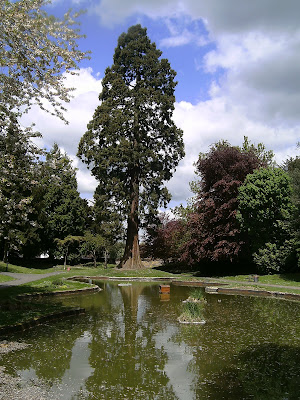
After church a walk up the high street, with a large conservative club and a larger baptist chapel. Tring has a natural history museum, the collection of Lionel Walter Rothschild which consists of rather depressed looking stuffed fauna and plaster casts of animals, all displayed rather dustily. I suppose they're not easy to clean. Still this is a good way of getting near to the creatures without being kicked by a cassowarie, who can disembowel a person with a single kick. Lord Rothschild hept these on his estate along with zebras to drive his carriage and giant tortoises from the galapagos islands. After a look round all six galleries I left and, after a very helpful encounter at the Tourist Information office in Tring, set out to walk to Aldbury along the road past Tring station, a distance of 2 and a half miles (running total 4 miles). I called in first at the memorial gardens to those killed in world war II with its sentinal tree overlooking a free form pond with ducks.


At Aldbury the Church of St John the Baptist contains the Pendley chapel with a parclose (stone) screen and an altar tomb with effigies. This is the only parclose screen in the chilterns. There is a curious wild man on the tomb at the feet of the Knight.


The church is near a pleasant village pond overshadowed by the stocks, with a sign exhorting visitors not to touch the ancient monument, although I'm sure people do, especially as the sign can only be seen one way. Many of the houses here belong to the Duke of Bridgewater who built the Grand Union Canal and whose initial and coronet appear carved in stone on cottages that could not bring shame...

The Valiant trooper pub on the way to the Grand Union Canal provided a stop for refreshment and then I headed off over fields to the canal.

A rare picture of me sitting on the banks of the canal

The walk by the canal in the heat of the day seemed long - around 5 miles to Berkhamsted measured by Grand Junction Canal milestones measuring distances to Braunston (running total 9 miles).
Berkhamsted is home to a minor public school where Graham Greene's father was head teacher, and has a mile long high street. (Total ten miles.)
Berkhamsted was home to Dean Incent, dean of St Pauls, founder of the school at Berkhamsted and assistant to Thomas Cromwell at the dissolution of the monasteries.

Berkhamsted was also a port and this curious victorian warehouse is the remains of that era on the Grand Union Canal

I always like Hertfordshire whenever I go - it probably helps that I go in good weather - but today was a good day out even if the ten mile walk was tiring.