Showing posts sorted by relevance for query southend. Sort by date Show all posts

03 May, 2007

Southend and Rochford

A visit to Southend. Southend is an Essex seaside resort with the usual facilities, including the longest pier in Britain. The pier is so long there is a railway on it to take visitors to the end. I didn't go on the pier but I walked along the front, although it is a River Thames estuary front rather than a sea front. On the front there was a party of girls from a girls school who asked me if I could answer some questions. I was desparate for the loo at the time so I couldn't oblige.

However I did speculate on the nature of the questions: Are you in Southend for business or pleasure?
For pleasure.
Are you having any?
I don't think I should answer that one.

I wasn't having any pleasure at the time. Westcliff on Sea was a higher class part of Essex with the Southend Art Gallery (closed for lunch).

Rochford

In Rochford there are many old houses including Lord Riches almshouses built for poor folk in Shakespeare’s time. Rochford hall was where Anne Boleyn was born, but that house has been demolished and the present house, once a refuge for displaced puritan ministers is now a clubhouse for golfers. Penelope Devereaux was loved by Philip Sydney, one of the cavalier poets but she married Robert Rich who followed the puritan way of life. Rochford old church owes its grandeur to the hall and its tower is a fine example of early Tudor brickwork.


15 June, 2013

Southend on Sea's six museums.

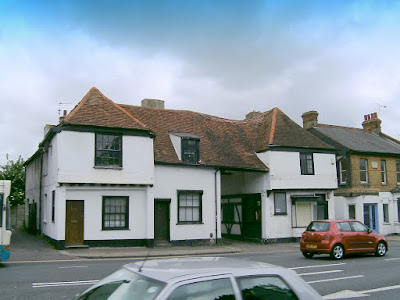
A day of heritage in Southend - not least my lunch. I've never really done the historical bits of Southend itself. True I've walked to Hadleigh Castle but that just passed Southend by. I've also tried to get in to the Art Gallery before although not successfully. I decided to do all the museums in Southend today with the exception of the Town Museum and Planetarium. My first was the cliff lift. For £1 it will take you from the cliff to the estuary front and back again, or vice versa. You also get the pleasure of the attendant's genial company. The lift closes about 1710 so there's no night service. Some of these installations are called cliff railways. Not sure what the difference is. Prittlewell square is at the top of the cliff and I took this arty picture to show how bright the day was, which doesn't always come across in my other pictures. The Beecroft Art Gallery, given by Alderman Beecroft in the coronation year of 1953 had a few exhibitions on, one a group of artists from Chelmsford, another of some of the art from the permanent collection, paintings and posters and some photography of beach huts, which were very colourful. The lighting was far too low to appreciate the permanent collection which was a pity because they looked quite nice. During my break for lunch I was seduced by the 1950s typography of the menu and the 1950s atmosphere of the cafe into some of the worst 1950s food you could get. Although I grant you it was cheap. Chicken pie was not on the menu here so I can make no comparisons. So I had my lunch and set off for Southchurch Hall which is a moated meadieval hall house with an extension firmly in the latter part of the twentieth century and victorian bedrooms etc. The service end of the hall is set out as a kitchen and the other end is done out for dining. There are two solars attached and a bedroom above the south solar, that is open to the public. The hall was restored in 1930 and used as a library but later became a museum. I enjoyed that one very much. In the surrounding park, presumably the grounds of the house there was a lake with two families of red snapper terrapins in them. The poor things looked a bit muddy though. Here is another pic of Southchurch Hall After leaving this house I was to walk up to Prittlewell Priory a former cluniac priory made into a vicorian house. However inclement weather made me take shelter in the Town Museum although there is not much there. A display about EKCO radio and a big fireplace being the main points of interest. Prittlewell Priory is heavily restored but well restored. The park was given to the town in 1917 together with the mansion. It was interesting to see the rooms including the cellars. On the way I saw a very old place called Swan Hall and this old place that was called nothing at all.

02 October, 2011

Southend on Sea to Hadleigh Castle.

On perhaps the hottest day in October - at least so far - I decided to have a trip to the seaside with a long walk from Southend on Sea to Leigh on Sea with an impromptu walk up to Hadleigh Castle. I managed to persuade a friend not to go to work today and he suggested Leigh rather than Brighton, which I always tend to look at first.

Starting off at West Ham station I was surprised to be given a single ticket instead of the usual '2-part return'.

Neither of the two towns are actually 'on sea' as they are both on the Thames Estuary. Of my trips to Southend I have never really seen it in the sunshine, only having been there on dull days. However Southend seemed rather pleasant in the sunshine with some fine gardens, especially heading towards Chalkwell.

After a brief shopping expedition in the town to buy some water for the journey, it was down to the sea front and off to the west for our walk to Leigh. There were many people taking advantage of the unusually summery weather, including the amusement proprietors. I was wondering if they had hastily re-opened after the season. The first point of interest was a single track cliff railway, which I had not seen on previous visits to Southend.

Afterwards, towards Chalkwell was an obelisk, the crow stone, erected by the Port of London Authority to demarcate where the City of London's jurisdiction over the Thames ended. Until 1857 the mayor and aldermen of the City used to row out to the crow stone to secure their rights over the Thames, which they had bought off Richard I who was financing crusades. After that time the PLA took over.

The Port of London Authority's jurisdiction ends much further out, beyond Shoeburyness but this historical marker, half drowned at high tide marks a point of history.

After an ice cream (Mr Whippy 99) and a bit of a sit down we began strolling along the sea front. After Chalkwell, the river became more leisured with the path running between sailing clubs and the railway line. On coming to Leigh on Sea with its cobbled High Street we decided to have some lunch in the Mayflower public house, which had converted some of its rooms into a rock shop, an ice cream parlour and a takeaway. After a long queue, I don't think it was really half an hour, we had some excellent chips sitting on the tiny harbourside looking at the two fishing boats and watching people disporting themselves in the water and throwing mud at each other.

After lunch we had a look at the tiny museum in Leigh, including an old fisherman's cottage furnished as it would have been a hundred years ago, and perhaps even later than that. There were some interesting exhibits including model shops.

Making our way down the High Street one of the pubs had a very good mod band playing outside. We stayed for a couple of numbers.

After that we continued our walk to Hadleigh Castle. Hadleigh castle is surrounded by a Salvation Army farm, that started life as 'Hadleigh Farm Colony' at some stage used for training men (of course) for emigration to 'the colonies'. It was never a colony for inebriates, even though the nearby country park is home to some rare invertebrates. The Salvation Army had erected a notice prohibiting letting off fireworks on their land. Whether this is a general nuisance or just for 5th November was not stated.

The castle itself is more of an observation post and with the spectacular views over the Thames would have been a very good one.
Henry III resided there using the great hall (which wasn't very great) and the solar behind, almost as big as the great hall. Only an observation tower is left standing as the land was and is unstable and subject to landslips.

After a look round the castle it was time to return to Leigh on Sea station for a weary journey home.

07 March, 2010

Southend and Basildon

I've posted about Southend before and the place hasn't changed much since then, here is a picture of the Estuary front.

On the way back from Southend I stopped at Basildon, another new town. I’ve written elsewhere about Harlow and it is interesting to compare the two. Harlow dates from 1947 and Basildon from 1948 but they seem to be worlds apart, although this may be just familiarity. Basildon seems to bustle more than Harlow but has fewer artworks in the town. The oldest sculpture is on the side of ‘Freedom House’ (what a name) and is an abstract. Untitled, it is by A J Poole and was installed in 1957.

The sculpture of a mother and child in the fountain is interesting and is opposite the former co-operative store now occupied by Primark (as at Stevenage). The fountain was installed in 1962 and is black as coal. In the background is Brooke House also built in 1962, (did the council raid the housing account to pay for it one wonders?) a block of flats named after a Housing minister and designed by Sir Basil Spence. The only bit I could see was the lift lobby which was lined with marble and mosaic. A fitting setting for working class housing.


The Church of St Martin of Tours (Church of England of course) claims on its website that the church gardens make a pleasant place to sit, as well they might if they were not locked away behind 5 foot iron bars. The gardens have fountains playing round the side chapel of the church, although difficult to photograph. The church itself is attractive with a sculpture of Jesus over the door waiting in welcome and stained glass windows up to head height in the walls giving a floating impression.

The detatched modern campanile contains an 11cwt ring of 8 bells including the tenor cast in the 15th century and treble and second cast in 1997. The campanile was opened by the queen on my 32nd birthday


The library was quite well stocked with local history books although the books argued which shop had been the former co-op. I could not find out if it had been London Co-op Society, which was most likely, or Chelmsford Star Co-op which was the geographical best fit. There are a good few charity shops in Basildon and I bought a jug (£5 marked down from £15 although I even thought £5 was a little steep – cancer research are always pricey). It was dated 1943 and just as I got it home I dropped it and chipped it – blast! There were the usual pound shops but there was a Debenhams Department store.

There’s a very good train service from Basildon to Fenchurch Street.