20 January, 2012

Liverpool

I've never been to Liverpool before, even though it was one of the Universities that examined me for 'O' and 'A' level. I have been to Manchester, Leeds Sheffield and Brumagem but never to Liverpool.

It was with some trepidation I approached because I once read a piece of poverty porn called 'Twopence to cross the Mersey' and of course Liverpool was the childhood home of John Lennon who wrote the miserablists anthem 'Imagine' which is breathtaking in its nihilism. There are other examples - Alan Bleasdale the Liverpool playwright springs to mind. So I wondered what the city would be like - children in rags perhaps, dour, grumpy people and streets filled with beggars. I don't know about the suburbs, which may well be quite dire but I was very pleasantly surprised by the City Centre. Firstly the hotel room had a view of both the Cathedral and the RC Cathedral which both looked very fine in their diverse ways.

First port of call was the Museum of Liverpool which concentrated on the history of Liverpool including its popular culture, engineering and sporting achievements. Apart from the rude schoolchild this was an amazing space in a modern building on the waterfront near to the Three Graces, the Liver Building, The Cunard Office and the Port of Liverpool Offices. All these buildings are very fine and display very well in their waterfront setting.

After the museum, it was time to go to the Cathedral. Liverpool Cathedral, the largest in the UK, was designed by Sir Giles Gilbert Scott (a Roman Catholic - the RC Cathedral was designed by Frederick Gibberd who was Church of England) in the Gothic style, brick with ashlar facings and incorporating concrete into the structure for the vaulting. It is a soaring space, reminiscent of Guildford, and was concieved in 1901. The Lady Chapel was the first part of the cathedral to be built in 1910 and contains a window paid for by the Girl's Friendly Society commemorating women of local and national influence including Kitty Wilkinson (friend of the poor and needy of Liverpool) Elizabeth Fry, Grace Darling and Baroness Burdett Coutts as well as others. There were artworks in the cathedral two different pictures of the Good Samaritan in very different styles but very good.
The lift to the tower top followed by 108 stairs above the bell chamber was quite scary but also thrilling.
On a better day - it rained when I was up there, I could have stayed there for a long time. Sight lines were not good from the tower top as there were small embrasures to look out of rather than something a little wider.

The second day was wet so we went to the Maritime museum which had lots of artefacts relating to the see including ship models which I like.

I get the impression that there is much more to see and do in Liverpool and I shall definitely be coming back. As for those children in rags and grumpy people - they were nowhere to be seen.

17 January, 2012

Morcambe - Beauty surrounds and health abounds

A visit to Morcambe in Lancashire. There does not seem to be much to do there - there is an indoor market but not much else. I think that Lancaster Council does not do much to promote Morcambe. Morecambe does have its attractions though, even though it faces north. Eric Morcambe took his stage name from the place and his statue is on the sea front, in a charachteristic pose. There is a panorama of the Cumbrian Hills in iron on the front too.

Morcambe is also fond of seagulls which appear on the bollards and sculpture in the town, including this one on the stone jetty. The Jetty was built in the 1850s as a rail terminal for people catching ferries. It didn't catch on though, and now is just a pleasant walk out into Morecambe Bay. There are various artworks, including 'Magpie Hopscotch'.

The main attraction is the Midland Hotel, built in the 1930s as a new railway hotel the war interrupted any hope of it making a profit. Until recently it was derelict but has now been restored by Urban Splash, although sadly some of the minor artworks have been destroyed.


Some do remain including this cieling painting at the top of the central staircase.

13 December, 2011

Preston in Lancashire Recusant council

A visit to Preston on the way home from Barrow. The Harris Museum was closed last time I called as I had called on a Sunday, although the library was open which I thought strange. Nevertheless on a Tuesday everything was open. I started at the top with the art galleries which contained a good mix of art from most centuries. The kindly gallery attendant gave me some leaflets including a historical walk around Preston (of which more later) then began to talk about anything other than painting. Perhaps people usually come in for a warm from the very chilly winds. There was a Stanley Spencer in the gallery and some lovely nineteenth century genre paintings. Portraiture was less interesting although Pauline in a yellow dress caught my eye - the 1944 Mona Lisa.

Leaving the Museum I decided to take the historical walk. This did not start too well - the Old Bull's Head where some election shenanigans took place took precedence to the Minster church of St John and St George. I began to suspect Preston was a rather recusant borough, especially as their badge is a lamb and flag. Missing out the church the next port of call was a fence - previously the site of the Temperance Hall. Formerley a cockpit where people bet on cocks fighting for money it became a place where people signed the pledge. A redemptive change of use. Demolished.
The next place on the walk was where Arkwright invented a spinning frame, and kick-started the industrial revolution. This was the house he lived in.
The next two places on the itinerary were car parks - Look one is the site of a big factory. Demolished. The other the site of the town gas works. Demolished. Oh dear - best to show people something other than car parks (and not even a good one - see later). The Gas Company was started by an RC priest... After looking at a gold thread works (converted to flats) and a statue of Sir Robert Peel in a square, it was time to go past the RC church (even invited to go inside - not me thanks) and the RC School - the first to be gas lighted which I suppose it would be given the founder of the gas company. Strange that the RC church should be mentioned and not the Established church...

The Corn Exchange, the hall of radicalism, was next on the list with its monument to cotton workers killed by the militia in 1842 during a period when mill owners reduced pay by 10%. The walk ended at a massive covered market.

It's rather a pity that nobady thought to include the best car park and bus station in the North West on the tour. Preston Bus station goes on for miles and is an iconic 20th century marvel, well deserving of listing. I used it once and it was easy to use.

There is also a rather nifty taxi rank. All in all Preston was pleasant if chilly.

03 December, 2011

Farnham and Aldershot.

Farnham is a charming little Surrey market town with a castle previously belonging to The Bishop of Winchester. The town is the most westerly in Surrey, just on the Hampshire border.

The castle is in two parts, the Medieval keep and the Bishop's palace bit. The keep is over 900 years old in its oldest pit - a really deep hole in the motte part and was broken down by Cromwell's army. The Bishop's Palace looked pretty much Tudor although built on a Medieval foundation, especially the brick built tower with polychrome brickwork. This looks a bit like Lambeth Palace.

The custodian for English Heritage at the castle keep (the only part open to the public and free) was friendly and helpful and showed me the exhibition about the castle and its bishops.
Castle street is a pleasant street of houses with georgian facades, and the tiny Windsor almshouses, built 'for the habitation and relief of eight poor honest impotent old persons'. The tiny gables and large chimneys give a quaint air to these tiny houses.
The museum explains that Farnhaam has been kept very much in an original state by the work of some estate agents on the Farnham UDC who were keen on conservation of the historic buildings and that everything should be in keeping. And a good job they made of it too. This does not mean that modern art was neglected - the Post Office Mural is a good example although not well maintained.
The Police station also has murals, but a lot less abstract.
Faarnham is the birthplace of William Cobbett who polemicised about the plight of agricultural workers. A tablet to his memory is in the church and his tomb is near the north door.

The church is dedicated to St Andrew and has been re-ordered with chairs in the nave and what the congregation call pavillions, which provide a children's corner, kitchen facilities and flexible meeting space. It's a very big church and these pavillions seem to fit in well with the architecture, although I wasn't sure about the table, lectern and font which looked like posh kitchen units.

Aldershot, or as a friend calls it 'Aldershit' is in Hampshire. Not much of interest architecturally really but it is an army town as was made very clear by a man shouting to his wife with a real parade ground bark. Dearie me.

16 October, 2011

A visit to Kenilworth

Kenilworth will be forever associated with Sir Walter Scott's eponymous (always wanted to use that word) novel. There is no railway to the town so it is a case of get off in Leamington Spa and take a bus.

The day started rather badly when Chiltern Trains had a train that was late! Hardly Deutsche Gerundlicheit. This caused me to miss out on a McD's breakfast. So I had to have one in Leamington when I was rather hungry. I went to Wetherspoons (big mistake) and had the large vegetarian breakfast. Supposed to come with three sausages I only got two so had to ask the waitress for another. It arrived as I was finishing. However it was vital minutes of the day wasted with waitress service and time taken to order food. Luckily the bus to Kenilworth was just pulling in to the stop as I came out of the pub. The bus journey was delightfully provincial with the driver stopping the bus to take a mobile phone call, and when one of his friends got on to have a conversation about the friends tattoos - apparently a special ink that doesn't crack with muscular movement. Anyway these things make life worth living so the journey seemed to be over in a flash.

Kenilworth is a town of two halves with the modern shopping and residential area to the south and the more Georgian part and the castle to the North. But before we get to the castle, there is the medieval abbey to look at. Only the gatehouse and a few forlorn walls survive and this building that has been called a barn (but nobody is aware of what it really is)

I am wondering if it was a hermitage of the kind the carthusians had? The abbey was augustinian but did they have hermits?

The Church of St Nicholas (patron of fishermen as the abbey fishponds were extensive) was for the townspeople and lay brothers of the abbey. There is a wonderful porch incorporated into the tower and the church has some good stained glass including an Elizabethan window. A victorian clergyman took it upon himself to undo what the reformers had done to the church. He raised the chancel and removed the flat ceiling, no doubt making the congregation cold. There's not much more to say about the church except it was open when I called.

The next big thing is the castle. English heritage really should take some lessons in customer service. As I had approached the castle from the gatehouse by a public footpath an official tried to accuse me of going in without paying! The irony was that I was on my way to buy a ticket. I should just have walked in without paying!
Never the less the castle was an imposing love nest for Robert Dudley, Earl of Leicester and his paramour Queen Elizabeth. Robert Dudley practically rebuilt the castle in Elizabethan style (Hardwick Hall more glass than wall)
so the Queen would only see Tudor rather than Medieval. The castle is one of the ruins that Cromwell knocked about a bit as his men demolished the 14ft thick keep wall and opened a view of the Elizabethan knot garden.
Cromwell's men also drained the mere, a semi ornamental lake on the North side of the castle by breaching the dam. That leaves the ruins we see today.
The gatehouse is set up as a gentleman farmer's home with a tester bed (Queen Elizabeth didn't sleep in it) and a fireplace from the castle carved with Robert Dudley's motto 'Droit loyal'.
The castle is inextricably knotted into the history of the monarchy - John of Gaunt the first Duke of Lancaster modernised the castle, it was besieged by the King's troops during Simon De Montfort's rebellion, and Queen Elizabeth slept there. Truly remarkable.

02 October, 2011

Southend on Sea to Hadleigh Castle.

On perhaps the hottest day in October - at least so far - I decided to have a trip to the seaside with a long walk from Southend on Sea to Leigh on Sea with an impromptu walk up to Hadleigh Castle. I managed to persuade a friend not to go to work today and he suggested Leigh rather than Brighton, which I always tend to look at first.

Starting off at West Ham station I was surprised to be given a single ticket instead of the usual '2-part return'.

Neither of the two towns are actually 'on sea' as they are both on the Thames Estuary. Of my trips to Southend I have never really seen it in the sunshine, only having been there on dull days. However Southend seemed rather pleasant in the sunshine with some fine gardens, especially heading towards Chalkwell.

After a brief shopping expedition in the town to buy some water for the journey, it was down to the sea front and off to the west for our walk to Leigh. There were many people taking advantage of the unusually summery weather, including the amusement proprietors. I was wondering if they had hastily re-opened after the season. The first point of interest was a single track cliff railway, which I had not seen on previous visits to Southend.

Afterwards, towards Chalkwell was an obelisk, the crow stone, erected by the Port of London Authority to demarcate where the City of London's jurisdiction over the Thames ended. Until 1857 the mayor and aldermen of the City used to row out to the crow stone to secure their rights over the Thames, which they had bought off Richard I who was financing crusades. After that time the PLA took over.

The Port of London Authority's jurisdiction ends much further out, beyond Shoeburyness but this historical marker, half drowned at high tide marks a point of history.

After an ice cream (Mr Whippy 99) and a bit of a sit down we began strolling along the sea front. After Chalkwell, the river became more leisured with the path running between sailing clubs and the railway line. On coming to Leigh on Sea with its cobbled High Street we decided to have some lunch in the Mayflower public house, which had converted some of its rooms into a rock shop, an ice cream parlour and a takeaway. After a long queue, I don't think it was really half an hour, we had some excellent chips sitting on the tiny harbourside looking at the two fishing boats and watching people disporting themselves in the water and throwing mud at each other.

After lunch we had a look at the tiny museum in Leigh, including an old fisherman's cottage furnished as it would have been a hundred years ago, and perhaps even later than that. There were some interesting exhibits including model shops.

Making our way down the High Street one of the pubs had a very good mod band playing outside. We stayed for a couple of numbers.

After that we continued our walk to Hadleigh Castle. Hadleigh castle is surrounded by a Salvation Army farm, that started life as 'Hadleigh Farm Colony' at some stage used for training men (of course) for emigration to 'the colonies'. It was never a colony for inebriates, even though the nearby country park is home to some rare invertebrates. The Salvation Army had erected a notice prohibiting letting off fireworks on their land. Whether this is a general nuisance or just for 5th November was not stated.

The castle itself is more of an observation post and with the spectacular views over the Thames would have been a very good one.
Henry III resided there using the great hall (which wasn't very great) and the solar behind, almost as big as the great hall. Only an observation tower is left standing as the land was and is unstable and subject to landslips.

After a look round the castle it was time to return to Leigh on Sea station for a weary journey home.

10 September, 2011

Swarthmoor Hall

Another heritage open day, this time at the home of Margaret Fell, the mother of Quakerism.

Swarthmoor Hall is an Elizabethan manor house just between Ulverston and Swarthmoor built in 1586. It may have been built on the site of an earlier dwelling but records are hard to find from that era. It is now owned by the Religious Society of Friends who operate it as a hotel and conference centre, and have furnished six rooms as they would have been furnished at the time of George Fox's visits to the hall. The first room you go into is the Great Hall with a long refectory table an panelling from 1912 by Emma Clarke Abraham including wyverns. The rooms have been furnished with care and there are some fine artefacts, including a copy of the Great Bible of Myles Coverdale, the bible from which the Book of Common Prayer lectionary is taken. There is also George Fox's travelling bed - weighing a ton.

The hall was renovated from 1912 by Emma Clarke Abraham who carved the panelling in the Great Hall herself. She had windows unblocked and the structure made sound.

The real story of Swarthmoor is that of Margaret Fell. Born in 1614 in the reign of James I and VIshe lived throughout thr reign of the Stuarts dying diring the reign of Queen Anne.
During her longlife she married Judge Fell, who opened Swarthmoor to travellers for hospitality and who also allowed dissenter preachers to stay and preach, most unusual for the times. After a long and happy marriage to Thomas Fell, eleven years later she married George Fox, founde of the Friend's Religion. Imprisoned for preaching within her own home she was thrown into a dungeon in Lancaster Castle for four years, a most unpleasant experience that I have had, even though I was in for four minutes and voluntarily. Undaunted by this she went to see the King when George Fox was imprisoned asking for his release. He was released but other Friends were imprisoned. Margaret Fell is one of England's bravest women.

09 September, 2011

Silverdale - the loveliest spot on Morcambe bay.

The weather was unkind when starting out but the rain didn't put us off. Silverdale is just over the border from Cumbria in Lancashire, and although we couldn't see very far into the distance we were able to see Morcambe bay. The Church of St John had some beautiful modern stained glass, which my camera fails to do justice to. Stained glass should be so easy to photograph but digicams have difficulty for some reason.

The church has capitals carved with biblical scenes in the spirit of the 14th century.
After a short walk across 'the lots' with its views of Morcambe Bay we went to a cafe for tea. As the sun had come out we decided to walk to Arnside, past the Leeds Children's Holiday Camp, founded in 1904 to enable poor children from Leeds to have a week's holiday in the fresh air with good food. A role still fulfilled today.

It was a very long way to get to Arnside, which was shown as being three miles, but was more than that. We didn't see the ancient monument at Far Arnside but has a lovely walk through the woods and along the coast to pleasant Arnside, a village alongside Morcambe bay.

Barrow Library Strongrooms

A photo free visit to Barrow Library Strongrooms. The strongrooms are to an archival standard and contain various treasures - including George Romney's sketchbook, a commonplace book of a yeoman farmer and bomb maps of Barrow. These are the treasures. Other things kept include filthy old rate books from the 1930s. Even the Librarian said that nobody ever looks at them. I suppose one might say the rates on my house were 19/6 in the 30s and the council tax is now £230. Beloved and I certainly enjoyed the tour, part of heritage open days.

04 September, 2011

Convalescence in Barrow - Piel Island and the Barrow Lifeboat

I have been quite seriously ill and am slowly recovering. After Church at St John's Barrow Island, an interesting concrete church of the 1930s, it was such a lovely day, beloved and I went to Piel Island. Piel Island was a Meadieval stronghold for the Abbots of Furness with the castle built about1200. The best way to access the island is by walking over the sands from Walney Island (this depends on the tide), however beloved and I decided to take the ferry. The ferry is a small boat completely exposed to the elements and driven very fast by a (hopefully) experienced ferryman. I found it difficult to get out but the ferryman was helpful. The castle was in ruins and some bits had fallen into the sea on to the shingle shore. but was mostly intact even if you couldn't get indide the keep. There is quite a bit of the keep left and a ruined chapel, although greatly ruined. After refreshment provided by the King of Piel Island - in reality the landlord of the pub - he's king because he's the only person who lives there all the year round. After a hairy ferry crossing back we went to see the Barrow lifeboat - a real ocean going craft. It was last launched on 28 August to rescue a yacht.

22 July, 2011

Egham Surrey

A rather whistle stop visit to Egham but I missed out Royal Holloway with its art collection. The College was up a hill and I didn't fancy the walk.

The late Georgian church was locked when I called but was quite pleasant outside.

The high street contained sculptures and plaques about King John and the Magna Carter, which was signed - where? Can anybody tell me? Yes Joe it was at the bottom. The Magna Carta was signed at Runnymede, near Egham. Time was limited so I didn't try to find this guarantee of the rule of law (and therefore lawyers). The museum has a reproduction of the copy in Salisbury Cathedral as well as memorabilia from the two Royal Holloway institutions.

There is also an old grammar school (now a sixth form college) curiously with an almshouse attached, although I don't think the almshouse is operational any more.

A prosperous and charming little town.

21 July, 2011

Bracknell in Berkshire

Another new town to add to my portfolio - a visit on a dull day to Bracknell in what used to be the County of Berkshire. Bracknell was designated a new town in 1949 so is one of the later ones. Like Crawley the church is the existing village church (built 1851) although locked when I called. Unlike Crawley the old high street was pedestrianised and made the main thoroughfare of the town centre.
There are a few old inns although I didn't take any refreshment there, including one with a milestone outside showing 28 miles to London and 11 miles to Reading (pronounced to rhyme with beading by the railway information person on Waterloo Station). The town had a quiet dignity about the main town centre and a fine historic former co-op store. There was a fountain which told the time every five minutes, although I watched it and I wasn't sure when it was in its time telling phase, also some of the jets were not working.


There were some fine sculptures and murals, good charity shops and a good library which gave me the location of the former co-op store: CRS so maybe formerly LCS. I didn't see any of the residential areas of the town but the town looked fine.

17 July, 2011

Llanthony Priory and Newport

A visit to Wales in the fantastic company of Bud and Keith - cheers for a great time guys!

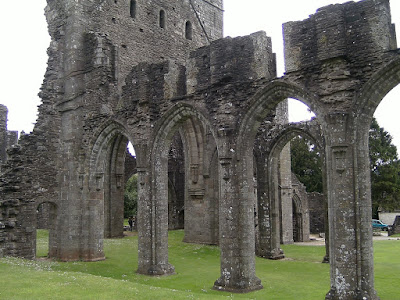
Llanthony priory is located in a very peaceful spot in the black mountains, so peaceful I nodded off to sleep for a few minutes. The priory church was completed around 1280 and ruined in the 18th century, to leave a charming spot for us to enjoy.


Newport is a little town with a good art gallery and museum - the collections looked pretty good for the size of the place with a good selection of periods and styles. I didn't have time in Newport to see the Cathedral, or the Castle but did take a picture of one of its oldest buildings - the murrenger's house.  A murrenger is an official charged with keeping a city wall in repair.
.
Newport also, like Middlesbrough, has a transporter bridge.

Newport is probably worth coming back to...

31 May, 2011

Dalston to Wapping (not all on foot)

Starting off at Dalston Junction station for a short trip down Dalston High Street and then up to Clapton seemed like a worthwhile walk. Passing Marie Lloyd's house too, which was surprisingly modest for a music hall star, especially one who fell foul of Mr Blushington of the London County Council on a mission to clean up the halls. "It's not what she said, it's the way that she said it!" But who can forget such classics as "She sits among the cabbages and peas" or "I always hold in having it if you fancy it". They don't make them like that any more. Arriving at Clapton I noticed a sculpture of some wires on poles next to a mosque, which looked rather like an eruv. Judge for yourself. The JC reported a rouge eruv round Clapton but this had been torn down. Nobody would say who by.
The next bit led through Springfield Park, next to Lea View House a model example of tenant participation. the Park cafe comes out well in this shot. A walk by the Lea or Lee River past where Avro aircraft were first flown on Hackney marshes led me to the abandoned Middlesex filter beds. These were filtre beds for water extracted from the river and were closed in the 1980s and left to nature.

Nature has taken over but it is managed, and there are one or two artworks in the filter beds. The whole place is rather sculptural though. After that a walk further along the River Lea or Lee to where the Lesney factory had been. This was where Matchbox toy cars were built and the developer has called the flats Matchmaker House. Matchbox House would be more apt given the size of the flats.
And speaking of matches I caught a bus to Bow and the former Bryant and May factory, with it's appropriate designs in the brickwork.
.
After Bow a walk down the Highway and past the Royal Foundation of St Katherine to Wapping. There in an old hydraulic power station is a work of art called 'making waves. It is a pool of water reflecting a structure which is like an illuminated ball gown. Very pretty.
After a drink in the Captain Kidd near execution dock it was time to go home.

30 May, 2011

Rainham to Purfleet London Loop Extension completed!

A long time ago I did the London Loop ending at Coldharbour point, the boundary of Greater London. That was as far as the loop went then but it has since been extended to Purfleet passing these old concrete barges that were dumped there after the war.
The loop follows the Thames at this point and includes the RSPB bird reserve which served as a convenient stopping point for coffee and scone or soup.
This building is just on the edge of Purfleet, where there is a military heritage centre and lots and lots of new flats. Come to think of it there were lots of new flats in Rainham too since I was last down that way - Messrs Chuckemup, Builders and decorators have been at it again.
The picture shows a surviving gunpowder store that hasn't been converted to flats.

29 May, 2011

A Ramble round Caterham

I've been to Caterham before but this was a chance to see some spectacular views. Well if there were no hedges in the way and I hadn't got lost in the Devil's Hole.
A steep climb out of Caterham took me along a ridge and out of the town to some rural farms, although passing the church in the valley. Walking through open countryside a slight deviation took me away from the Devil's Hole, a steeply wooded valley but I managed to regain it and end up back on the right track. After some farms and a clearing on Gravelly hill with a dog drinking fountain dedicated to Toby, I walked down through some woodlands to come to War Coppice Road with some houses that looked like they had been designed by Frank Baines for the Ministry of Works with street names like Woodland Way. After this I came to Whitehill Tower, an observation tower little more than a ruin. This was enclosed behind high walls due to be even higher but perhaps the country habit of leaving stuff unfinished will prevail.
After a few more miles of walking, past an interesting looking farm, I came to Caterham on the Hill, walking past some excellent homes for heroes and into Queens Park, with its tree planted to commemorate the relief of Mafeking, and a garden with a clock tower in it. The Old Church of St Lawrence was open and serving teas so I had a couple of pieces of cake in this 11th Century church. The church was found to be too small in the 1860s and a new church was built opposite the old one.
I went back down the hill into Caterham not on the hill and caught a train home. Not much to see on this walk but a few points of interest.